
Loyalty Fraud Prevention: Protect Your Program, Keep the Experience
One of the key experiences that makes your loyalty program valuable is the attack surface that fraudsters exploit. Here's how to defend the program without losing the customers you built it for.

Summarize this post with AI
Every loyalty point you issue is a liability on your balance sheet. A future cost: a discount, a free product, a reward you've committed to fulfilling. When a fraudster redeems those points instead of your customer, that cost hits your P&L without a matching revenue event. You paid for the acquisition, earned the purchase, and issued the reward. Someone else collected it.
Here's the tension most merchants don't recognize until it's too late: the frictionless experience that makes your loyalty program valuable is the same attack surface fraudsters exploit. Low sign-up barriers drive enrollment but invite fake accounts. Instant point crediting rewards fast purchasers yet enables return-and-re-earn abuse. Simple login flows reduce friction while making account takeover trivially easy. Every feature that delights customers also opens a door.
So what does practical defense actually look like? This article breaks down the three fraud vectors targeting ecommerce loyalty programs: external digital attacks, internal employee abuse, and policy exploitation. From there, you'll get an early warning signal checklist to spot fraud before it scales, plus a layered prevention framework built for growing ecommerce brands, not enterprise security teams with six-figure budgets.
Points Are Currency. Criminals Treat Them That Way.
Loyalty points carry real monetary value. They're redeemable for products, gift cards, store credit, and in some programs, direct cash equivalents. That makes every loyalty account a financial target. Fraudsters treat them accordingly.
The exposure is massive. In the U.S. alone, consumers hold billions of dollars in unredeemed loyalty currency across airline miles, hotel points, and retail rewards. Starbucks' 2023 10-K filing shows the company carried $1.6 billion in stored value card liabilities and deferred revenue from its rewards program. Delta Air Lines reported over $9 billion in loyalty program obligations the same year. These aren't abstract "rewards." They're balance sheet liabilities representing real financial commitments.
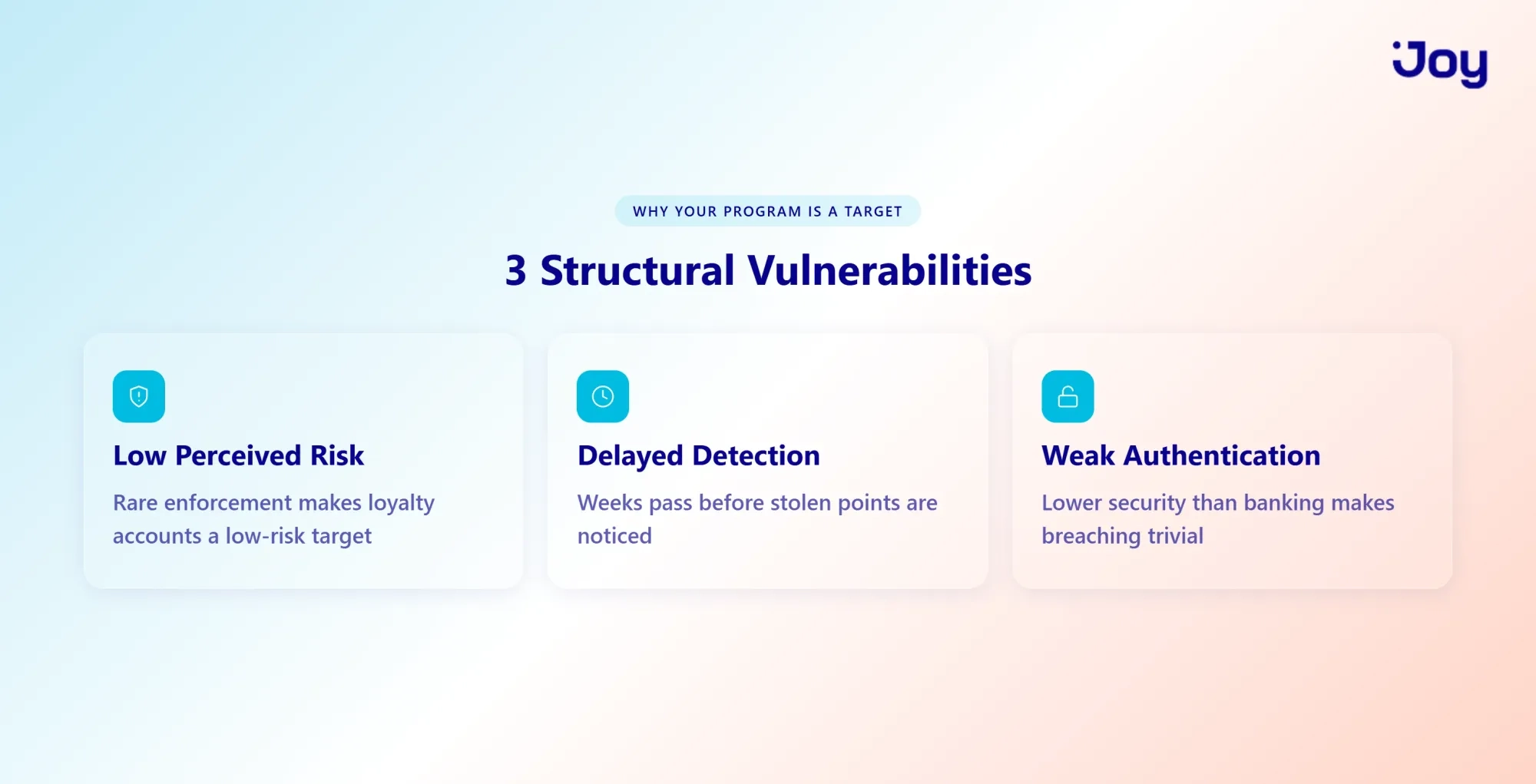
Why are loyalty programs so vulnerable? Three structural factors.
Low perceived risk by fraudsters. Most brands still treat point theft as a customer service issue, not a financial crime. Enforcement is rare, legal consequences are almost nonexistent, and the payout is immediate. For organized fraud rings, loyalty accounts offer a better risk-to-reward ratio than many traditional financial targets.
Delayed detection. Customers often don't check their point balances for weeks or months. On the merchant side, real-time account monitoring is uncommon. That gap between compromise and discovery gives fraudsters a wide window to drain value before anyone notices.
Weak authentication norms. Loyalty accounts have historically been treated as lower-security than banking or payment accounts. Simpler passwords, no multi-factor authentication, minimal login monitoring. All of which makes them far easier to breach.
These three factors create an environment where fraud isn't just possible. It's structurally incentivized. And the threat doesn't stop at one attack type. Loyalty fraud falls into three distinct categories, each with different mechanics, different actors, and different detection challenges.
> Related: Loyalty Program ROI explains how fraud directly erodes the return on your entire program investment.
A Taxonomy of Loyalty Fraud: Know What You're Defending Against
Most resources cover one or two types of loyalty fraud. Your program actually faces three distinct threat vectors, and understanding all three is the first step toward building a defense that works.
Type 1: External Digital Attacks
These are the highest-volume threats. Typically automated, operated at scale.
Account Takeover (ATO) is the most common form of digital loyalty fraud. The attack is straightforward: credential stuffing bots test username and password pairs from leaked databases against loyalty login pages. When they hit a match, the account gets drained within hours. What makes ATO particularly dangerous? The login itself looks legitimate. The credentials are correct, and in many cases the device fingerprint raises no flags. At scale, bots can test thousands of accounts per hour. This isn't manual exploitation. It's industrial.
New Account and Sign-Up Fraud targets the incentives brands offer to attract new members. Fraudsters create fake accounts to claim sign-up bonuses, referral rewards, or first-purchase incentives. More sophisticated operations use synthetic identities (combining real and fabricated data) to bypass simple email verification. A single actor can create hundreds of accounts and systematically drain welcome reward budgets before the pattern becomes visible.
Referral Fraud exploits the trust built into referral programs. The simplest version: self-referrals using multiple email addresses or devices. More organized schemes involve referral rings where one person refers a network of fake accounts to harvest referral credits. Either way, your referral program pays out acquisition rewards for customers who never actually exist.
Type 2: Internal and Employee Fraud
This is the largest blind spot across most loyalty fraud resources. And one of the most underestimated threats.
Internal fraud takes several forms. Employees with point-adjustment access can award credits to personal accounts or to friends and family. In physical retail or QSR environments, staff use discarded or photographed customer receipts to earn points on purchases they didn't make. Customer service agents issue "goodwill" points outside policy, sometimes legitimately but often without oversight or limits.
What makes internal fraud so easy to underestimate? Its pace. Unlike external attacks that spike and drain accounts fast, internal fraud is slower, smaller per incident, and harder to pin on any single person. But it accumulates. A $50 per month leak from one employee across 12 months is $600 in direct loss, and that's before factoring in the opportunity cost of misallocated rewards.
The clearest detection signal for internal fraud is concentration. If one employee or one store location accounts for a disproportionate share of manual point adjustments, that pattern deserves scrutiny.
Type 3: Policy Exploitation
Policy exploitation isn't hacking in the traditional sense. It's customers finding and repeatedly using gaps in your program rules.
Return-and-re-earn abuse is the most common form. A customer buys a product, earns points on the purchase, then returns the product. But the points aren't voided. Repeated at scale, this turns your return policy into a point-generation engine.
Tier gaming follows a similar logic. A customer makes bulk purchases to reach VIP tier status, extracts the tier benefits (free shipping, exclusive access, higher earning rates), then returns the original purchases. They keep the tier. You absorb the cost.
Bulk discount code generation exploits referral or promotional mechanics to generate redemption codes that shouldn't stack or accumulate. This often happens when referral incentives and promotional discounts interact in ways the program rules didn't anticipate.
And here's what makes policy exploitation especially tricky: the people doing it are often your highest-engagement "customers." Standard loyalty metrics make them look like VIPs. Their purchase frequency is high, their point balances are active, and their engagement signals are strong. It's only when you look at net margin that the picture changes.
> Related: Why Loyalty Programs Fail covers fraud and policy exploitation as two of the least-discussed reasons loyalty programs bleed ROI.
Five Signals Your Loyalty Program May Be Under Attack
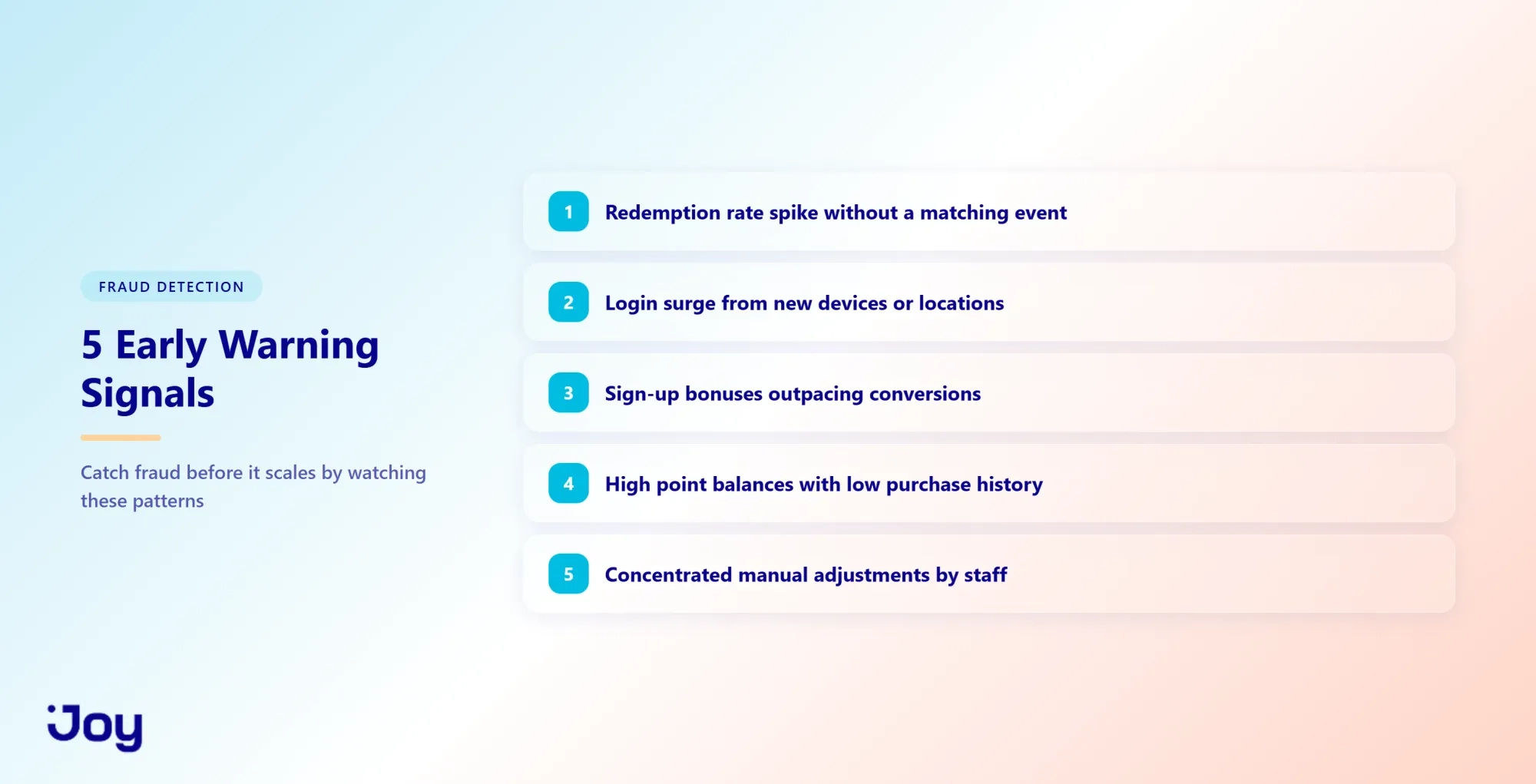
Fraud rarely announces itself. It hides inside your operational data until someone asks the right questions. These five signals are the earliest indicators that something's wrong. Catching them early is the difference between a contained incident and a systemic bleed.
1. Redemption rate spike without a matching event.
Start by baselining your redemption rate. A sudden spike, especially one concentrated in a short time window, is the clearest digital fraud signal. Legitimate redemption spikes follow campaigns, seasonal events, or tier upgrades. If nothing in your marketing calendar explains the increase, that's a flag worth investigating immediately. Platforms like Joy give Shopify merchants real-time redemption data that makes this baseline visible from day one.
2. Login volume surge from new devices or locations.
A single customer account suddenly accessed from a new country or an unfamiliar device? That's an account takeover flag at the individual level. At the program level, a spike in password reset requests is a leading indicator of an active credential stuffing campaign. Both patterns become visible only if you're tracking login metadata.
3. Sign-up bonus redemption outpacing new customer conversion.
If new account creation is high but those accounts never make a second purchase, fake account fraud is the likely explanation. In a healthy program, new accounts convert to a first purchase at a rate consistent with your organic baseline. A widening gap between sign-ups and conversions points to manufactured accounts claiming welcome rewards.
4. High point balances in accounts with low purchase history.
Legitimate high-balance accounts belong to frequent, high-spending customers. An account carrying 5,000 points with only two orders? That's an anomaly worth investigating. This pattern can indicate either an account that received fraudulent point transfers or an employee-created account accumulating unauthorized credits.
5. Concentration of manual point adjustments by staff.
If one employee or location accounts for a disproportionate share of goodwill credits or manual adjustments, that's an internal fraud signal. It doesn't automatically mean theft is occurring, but the pattern should trigger an audit. Most legitimate goodwill credit distribution follows a roughly even spread across staff and locations. Joy's audit trail lets merchants review adjustment history by staff account, making this pattern detectable without manual spreadsheet tracking.
> Related: Customer Loyalty Analytics explains why fraud detection starts with the same data layer as loyalty optimization.
Loyalty Fraud Prevention Framework: Technical Controls and Human Controls
Effective fraud prevention operates on two independent layers. Technical controls defend your program against external attacks like account takeovers, fake signups, and policy exploitation. Human controls prevent internal theft by structuring how your team accesses and approves loyalty operations. Neither layer works alone. You need both.
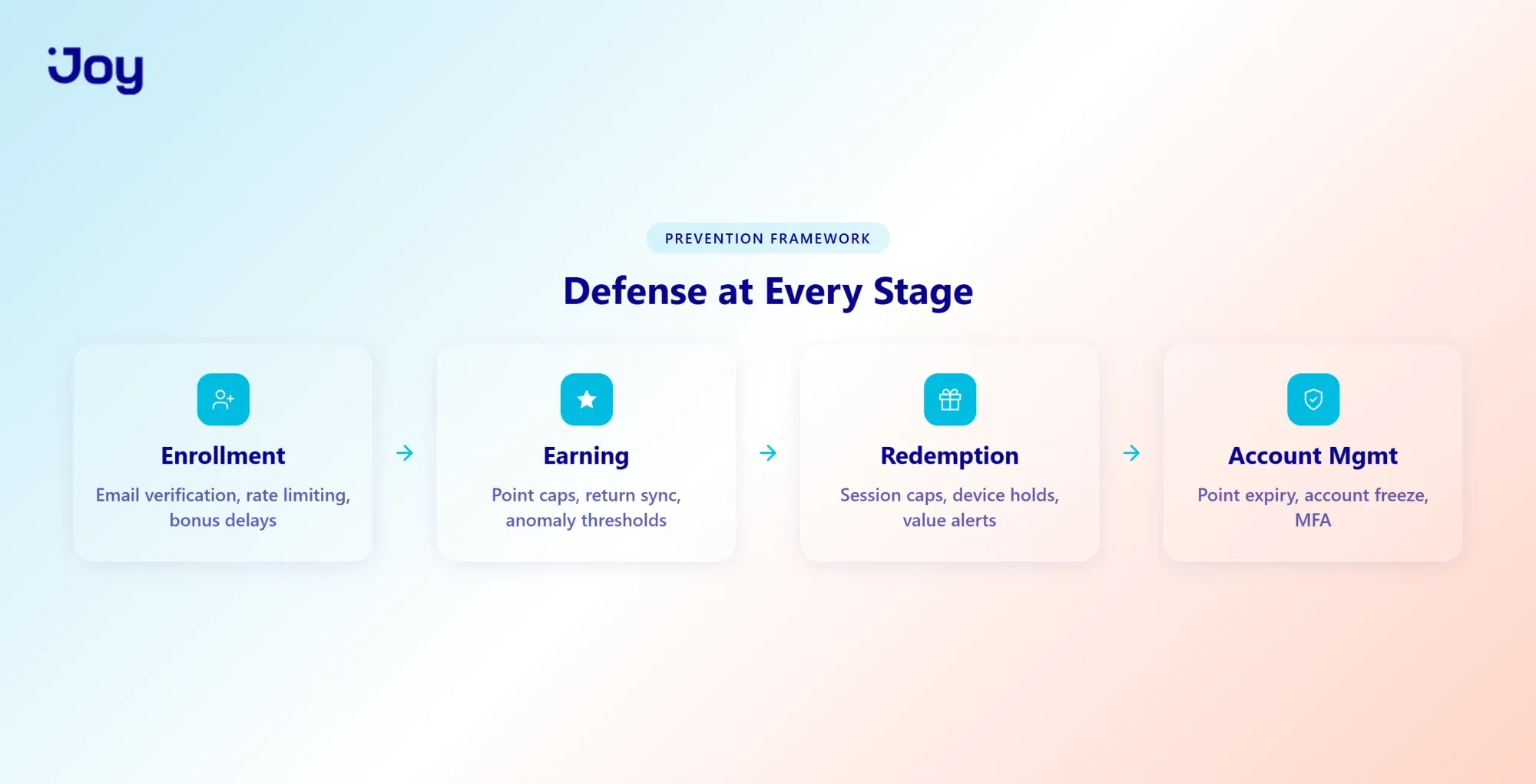
Technical Controls: Defend at Every Journey Stage
The key principle: match prevention intensity to risk level at each stage of the loyalty journey.
At Enrollment:
- Email verification plus sign-up friction. A confirmed email address eliminates the easiest fake account creation vector. Don't skip this step to speed up onboarding.
- Rate limiting. Cap the number of accounts creatable from a single IP or device per time window. This alone stops most automated sign-up abuse.
- Sign-up bonus delay. Don't release welcome rewards instantly. A 24 to 48-hour hold combined with a first purchase requirement kills most sign-up bonus farming.
- Referral gating. Require the referred customer to complete a minimum qualifying purchase before the referrer earns credit. This prevents self-referral loops.
At Earning:
- Point caps per transaction. This prevents single-event manipulation. A fraudulent $2,000 return-and-earn cycle nets far fewer points when a per-transaction cap is in place.
- Return policy sync. Void points when a return is processed. This requires your loyalty platform and your return logic to communicate. Confirm this is configured, because it's the single most common gap in policy exploitation defense.
- Earning anomaly thresholds. Flag accounts that accumulate points at a rate three to five times their historical average within a short window. This catches both external manipulation and internal abuse.
At Redemption:
- Redemption caps per session. Limit how many points can be redeemed in a single order or time period. Post-ATO account draining happens fast, so a session cap buys critical detection time.
- New device redemption hold. When an account is accessed from a new device and immediately attempts redemption, require re-authentication before the redemption processes.
- High-value redemption alerts. Trigger a merchant-side alert when redemption exceeds a threshold, for example, 500 or more points in one transaction. This gives you a chance to verify before the value leaves the system.
At Account Management:
- Point expiry rules. An active expiry policy limits the pool of accumulated points that can be stolen. A dormant account with three years of unspent points is a high-value target for attackers.
- Account freeze capability. When fraud is confirmed or suspected, the ability to immediately suspend redemption from a specific account stops the bleed while you investigate.
- MFA for high-value accounts. Require step-up authentication for accounts above a point balance threshold. Apply this proportionately, not universally, to avoid adding friction to low-risk accounts.
Human Controls: Prevent Employee Theft and Abuse
Most fraud prevention guides stop at technical controls. But internal fraud (employee theft, abuse of adjustment privileges) requires structural safeguards that technology alone can't provide.
Role-Based Access and Permissions:
- Granular staff permissions. Not all customer service agents should have the ability to adjust points or approve high-value redemptions. Define role-based access levels: junior staff can view balances, senior staff can issue manual credits, and management approves redemptions above a set threshold.
- Segregation of duties. The person who approves a point adjustment should not be the person who created the request. This single control prevents an employee from unilaterally awarding themselves points.
- Adjustment audit trails. Limit manual point adjustments to a small, auditable group. Track all adjustments by staff account and flag unusual patterns automatically.
- High-value redemption approval. Redemptions above a defined threshold (for example, 500 points or higher-value prizes) should require manager approval, not just settlement at checkout.
The combined effect of these controls is accountability at the permission level, not just the detection level. You're preventing internal fraud structurally rather than trying to catch it after the fact. Joy builds several of these safeguards directly into the platform: granular staff permissions, point adjustment audit trails, and redemption threshold controls give Shopify merchants the structural layer most loyalty tools leave out entirely.
> Related: Loyalty Program Best Practices covers why program security belongs in your setup checklist, not your incident response plan.
Fraud Response: The Steps Most Guides Skip
When fraud does happen (and at sufficient scale it will), how you respond determines whether you lose a few hundred points or lose the customer permanently. Most damage happens not during the fraud itself, but during a poorly handled response.
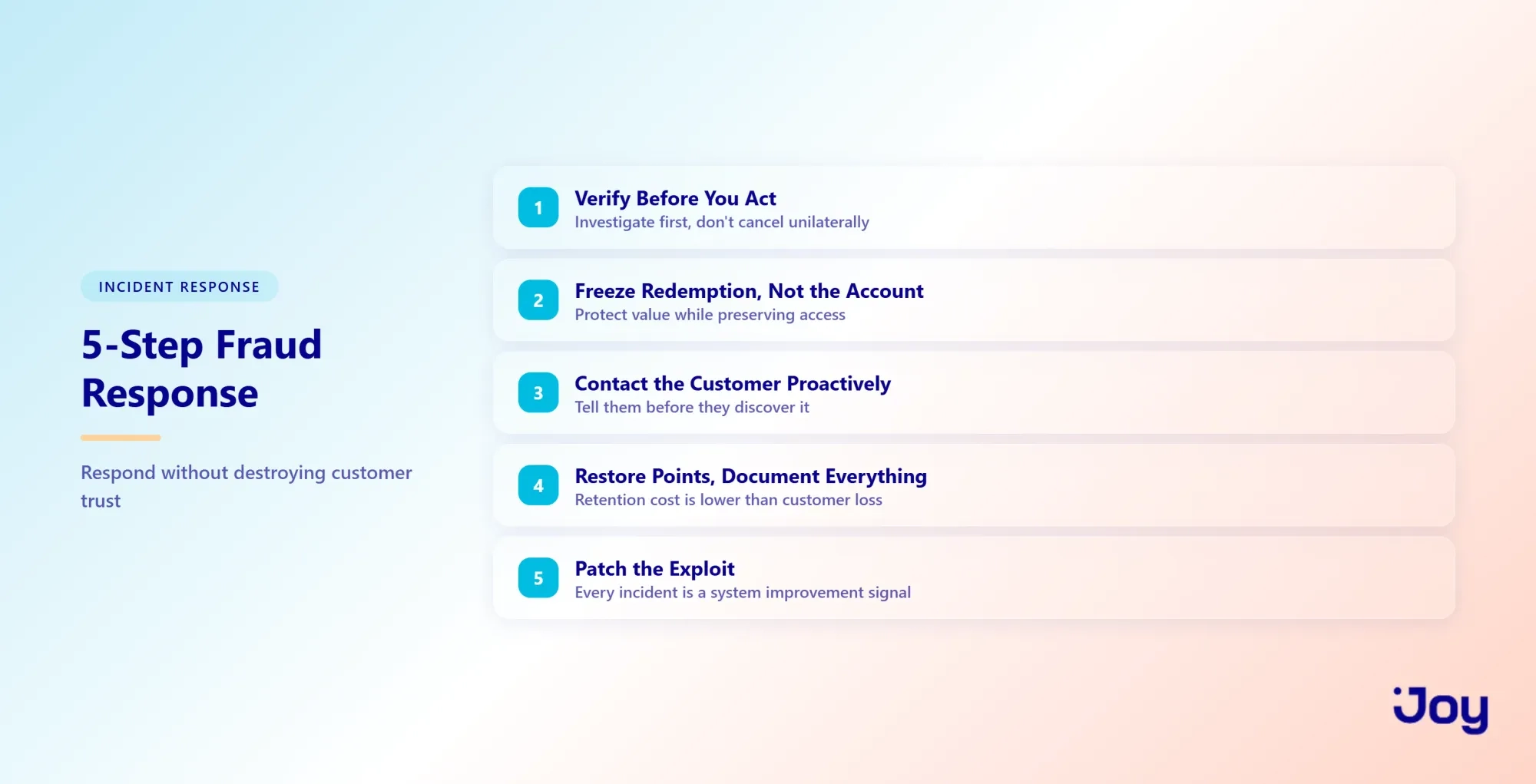
Step 1: Verify before you act.
Don't cancel accounts or void points based on a single anomaly signal. Investigate first. Check the purchase history, point earning pattern, redemption history, and device or location data. A rushed response that punishes a legitimate customer is worse than a delayed one that gets the facts right.
Step 2: Freeze redemption, not the account.
Suspend redemption access immediately while investigating. But don't lock the customer out of their account entirely. If they're a legitimate customer who was wrongly flagged, a full account lockout destroys the relationship. A redemption freeze protects value while preserving access.
Step 3: Contact the customer proactively.
If a customer's account was accessed without their knowledge, notify them before they discover it. The brand that warns you retains your trust. The brand you have to call to report the problem loses it. Keep the communication clear and specific: "We noticed unusual activity on your rewards account and have secured it. Your points balance has been restored. Here's what happened and what we've done."
Step 4: Restore points, then document the event.
Reinstating stolen points for verified victims is non-negotiable for retention. The cost of restoring 500 points is far lower than losing a customer who spends $2,000 per year. At the same time, document every detail: account ID, incident type, resolution action, and date. This builds pattern data that strengthens future detection.
Step 5: Patch the exploit.
Every incident is a system improvement signal. If a policy loophole was exploited, fix the policy. If a rule configuration allowed the fraud, update the configuration. If an access control was too permissive, tighten it. The goal isn't just recovery. It's making sure the same attack vector doesn't work twice.
> Related: Loyalty Program Redemption Rates explains why redemption patterns are your clearest fraud signal and your clearest health signal. Monitor both together.
A Secure Program Is a Program Customers Trust
Fraud prevention isn't a security tax on your loyalty program. It's a retention investment. A program that customers trust is a program they engage with, redeem from, and recommend to others. Every control you put in place protects not just your margins, but the relationship your customers built with your brand through their purchases and participation.
Loyalty fraud doesn't announce itself. It hides within your metrics, appearing as normal activity until the pattern becomes undeniable. The brands that catch it early are the ones watching the right signals: redemption rate anomalies, login surges, adjustment concentrations, and conversion gaps between sign-ups and purchases.
You've already built something valuable. Your customers chose your brand, joined your program, and within your metrics, appearing asengaged with your rewards. The question now isn't whether fraud will test your defenses. It's whether you've structured those defenses to catch it before it scales, respond without destroying customer trust, and improve with every incident.
Start with the five warning signals. Audit your technical controls against the enrollment, earning, redemption, and account management framework. Then look inward at your human controls: who has access, who approves, and whether every adjustment leaves a trail.
Joy gives Shopify merchants the account management, redemption controls, and audit visibility to run a program that's both generous and protected. If you're building a new program or tightening an existing one, start with Joy's free plan and configure your fraud defenses from day one.

Written by
Thomas Nguyen is the CTO of Joy, a loyalty solution for Shopify and eCommerce brands. With years of experience building high-performance Shopify apps, Thomas aims to help merchants grow through customizable and retention-focused tools.
Related reading
 Loyalty Strategy
Earn-and-Burn Loyalty Programs: All You Need To Know
Discover how earn-and-burn loyalty programs work, why they drive customer engagement, and how to design one that boosts revenue and retention.
 Thomas Nguyen
- Loyalty Strategy
Gamified Loyalty Program: Turning Rewards into Fun Experiences
From spinning wheels and earning badges to completing challenges and unlocking tiers, this guide explores how brands use gamification to boost loyalty—and how you can do the same.
Thomas Nguyen  Loyalty Strategy
Building Customer Loyalty: The Framework That Actually Works
Stable revenue can mask something uncomfortable: customers returning out of habit, not preference. When they find a better option, they leave without warning — and you pay full CAC to replace them. Here's how to build the loyalty they actually feel, not the one you assume.
Thomas Nguyen Loyalty Strategy
Pub Loyalty Scheme: How to Build One That Drives Repeat Visits
A pub loyalty scheme turns walk-in traffic into repeat revenue. Here's how to pick the right model—stamps, points, or tiers—stay compliant with UK alcohol and GDPR rules, and launch in 4 weeks.
Thomas Nguyen Loyalty Strategy
What Is a Loyalty Discount? (And How to Use It Without Killing Your Margins)
Most merchants avoid discounts because they fear training customers to only buy on sale. Loyalty discounts work differently: they reward earned behavior, not price hunting. Inside: what they actually are, six types that work for ecommerce, and the margin math that proves the ROI.
Thomas Nguyen Loyalty Strategy
The Ultimate Guide to Data-Driven Loyalty Programs
Learn how data transforms loyalty programs from generic point systems into powerful engines of personalization, retention, and growth, giving brands the insight they need to build deeper customer connections.
Thomas Nguyen