
Benefits of Brand Loyalty: Why It’s the Most Profitable Growth Lever for Ecommerce Brands
Want stronger retention and higher margins? Learn the true benefits of brand loyalty and how it drives long-term ecommerce growth.

Summarize this post with AI
Running an e-commerce brand today feels harder than ever. Ad costs rise, margins tighten, and what worked last year suddenly stops working. Even when revenue looks stable, growth can feel fragile.
That’s where brand loyalty changes the game.
But brand loyalty isn’t just repeat purchases. A customer coming back with a discount code is different from one choosing you over competitors without hesitation.
In this guide, we’ll break down what brand loyalty really means and how it directly improves retention, LTV, CAC efficiency, and referral growth. And then it becomes a growth strategy, not just a branding concept.
What Is Brand Loyalty? (And Why Most Ecommerce Brands Misunderstand It)
Most e-commerce brands think loyalty equals “they bought again.” That’s only part of the story.
Brand loyalty is when customers prefer you, trust you, and feel connected to what you stand for. They don’t just come back because of price. They come back because they want your brand.
When brands misunderstand this, they over-invest in discounts and points systems while under-investing in experience and identity. The result is repeat revenue that disappears the moment promotions stop.
To make this clear, let’s compare three commonly mixed-up concepts.
Brand Loyalty vs Customer Loyalty vs Loyalty Programs
Here’s how they differ:
| Aspect | Brand Loyalty | Customer Loyalty | Loyalty Programs |
|---|---|---|---|
| Core driver | Emotional attachment | Repeat behavior | Incentive structure |
| Why customers return | Preference & identity | Habit, convenience, price | Points, rewards, tiers |
| Stability | Strong & long-term | Medium | Depends on rewards |
| Competitive defense | Hard to copy | Easy to disrupt | Very easy to copy |
| Example signal | Customers recommend you without reward | Customers buy during sales | Customers redeem points |
Customer loyalty is behavioral. It shows up in repeat purchase rate, purchase frequency, and retention curves. Customers come back, but the reason might simply be convenience or pricing.
Brand loyalty goes deeper. Customers trust you. They align with your values. They recommend you without being asked. They are less sensitive to price changes and less reactive to competitor ads.
Loyalty programs are tools. They can encourage repeat behavior, but they do not automatically create emotional attachment. A points system might increase short-term frequency, but if the product disappoints, the program won’t save you.
Programs can support loyalty. They cannot manufacture it.
The strongest e-commerce brands treat loyalty programs as amplifiers of an already strong experience and brand story.
The 3 Layers of Brand Loyalty (Strategic Framework)
Brand loyalty usually builds in layers. If you understand these layers, you can diagnose where your brand stands and what needs improvement.
1. Transactional Loyalty (Discount-Driven)
This is the lowest layer.
Customers return because:
- They received a discount
- Shipping is fast
- The price is competitive
- They have points to redeem
This layer improves short-term repeat rate and revenue, which is useful. But it’s fragile. Competitors can out-discount you. Paid ads can pull these customers away easily.
If your repeat revenue drops the moment you pause promotions, most of your loyalty lives here.
It’s not wrong, but it’s not defensible.
2. Experiential Loyalty (Product & Service)
The second layer is built on consistent experience.
Customers return because:
- The product delivers on its promise
- Customer support solves problems quickly
- The website experience feels smooth
- Delivery is reliable
Over time, this builds trust, and trust reduces friction in future purchases..
This layer improves metrics like retention rate, customer lifetime value, and even operational efficiency because satisfied customers create fewer support issues.
Experiential loyalty is harder to copy because it requires operational strength. You can’t fake it with marketing alone.
When customers say, “I always buy from them because it just works,” you’ve reached this level.
3. Emotional / Identity Loyalty (Brand Alignment)
The highest layer is emotional and identity-driven.
Here, customers stay because your brand reflects who they are or who they want to be. They connect with your story, values, and community. Choosing you becomes part of their identity, which makes switching feel uncomfortable rather than logical.
At this level, customers:
- Refer friends without incentives
- Defend your brand publicly
- Search for your brand name directly
- Accept price increases more easily
This is where loyalty turns into a true growth engine. Emotional loyalty drives organic traffic, branded search, stronger word-of-mouth, and long-term margin stability.
It lowers your dependence on paid ads because customers actively bring new customers in.
5 Financial Benefits of Brand Loyalty (That Compound Over Time)
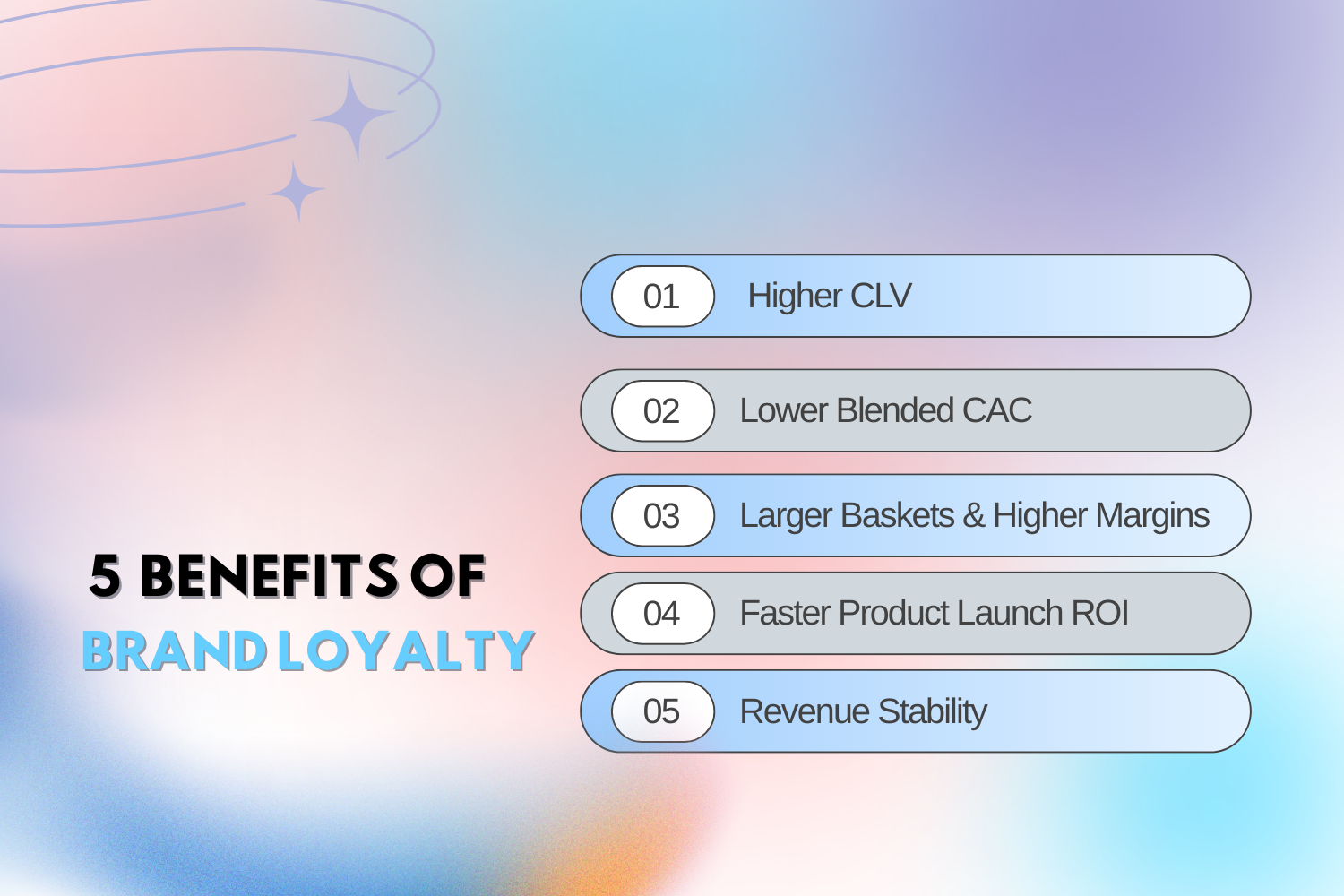
When brand loyalty is strong, it doesn’t just improve one metric. It reshapes your entire financial model. Instead of relying on constant acquisition, your business starts generating more revenue, more predictably, from the customers you already have.
Here are the 5 financial levers that loyalty strengthens, and why they compound over time.
Higher Customer Lifetime Value (Driven by Retention + Frequency)
Customer Lifetime Value (CLV) is the core engine of profitable ecommerce. If you increase how much each customer spends over their lifetime, you unlock the ability to scale more aggressively without destroying margins.
Loyal customers buy more often and stay longer. That combination alone can lift CLV by 20–50%, depending on your category and margins. Even small improvements in retention create disproportionate gains in lifetime revenue because every additional purchase stacks on top of the last one.
Higher CLV gives you room to reinvest in growth, experiment with acquisition channels, and absorb fluctuations in ad performance. Without strong lifetime value, scaling becomes fragile. With it, scaling becomes sustainable.
Lower Blended CAC & Faster Payback
Most brands try to reduce CAC by optimizing ads. Loyalty improves CAC from a different angle by increasing the revenue generated after the first purchase.
When existing customers come back and spend again, your blended acquisition cost drops automatically because you’re extracting more value from the same acquisition investment. Payback periods shorten, cash flow improves, and you reduce dependence on paid channels.
Loyal customers also bring in referrals and organic traffic, which lowers effective acquisition costs even further. Over time, this creates a healthier LTV:CAC ratio and reduces pressure to constantly chase new customers just to stay afloat.
Larger Baskets & Higher Margins
Trust changes buying behavior.
A study found that returning customers spend 67% more per transaction than first-time buyers.
When customers believe in your brand, upsells and cross-sells feel natural instead of pushy. They are more comfortable adding complementary products, trying premium versions, or increasing cart size. This increases Average Order Value without heavy discounting.
At the same time, loyalty protects margins. Customers who feel emotionally connected are less price-sensitive, which reduces the need for constant promotions and price wars. Even a 10–15% improvement in margin stability can significantly increase profitability at scale.
Instead of competing on price, you compete on value, and that shifts your entire positioning in the market.
Faster Product Launch ROI
Every new product launch carries risk. You invest in inventory, marketing, and creative without knowing exactly how the market will respond.
A loyal customer base reduces that uncertainty.
Loyal customers are more willing to try new releases and engage with launch campaigns. That leads to higher conversion rates during launch windows and faster inventory movement. Because you already have trust built in, you don’t need to educate the market from zero each time.
This shortens the time it takes for new products to become profitable and makes innovation more financially viable.
Revenue Stability & Higher Business Valuation
Retention stabilizes revenue. When a significant portion of monthly sales comes from returning customers, forecasting becomes more accurate and cash flow becomes more predictable.
This reduces seasonal volatility and protects the business during ad platform changes or market slowdowns. Instead of dramatic revenue swings, you get a smoother baseline that you can build on.
From a valuation perspective, predictable revenue and strong LTV: CAC ratios make your business far more attractive to investors or acquirers. Brands with solid retention often command higher multiples because their revenue is durable, not dependent on constant paid acquisition.
In short, when you step back, these 5 benefits don’t operate separately.
- Higher CLV lowers effective CAC.
- Lower CAC improves margins.
- Strong margins allow reinvestment into product and brand, which deepens loyalty even more.
That’s why brand loyalty isn’t just a marketing concept. It’s a financial growth system. And once it starts compounding, it becomes one of the most powerful advantages an ecommerce brand can build.
5 Hacks to Build Brand Loyalty Without Destroying Margin
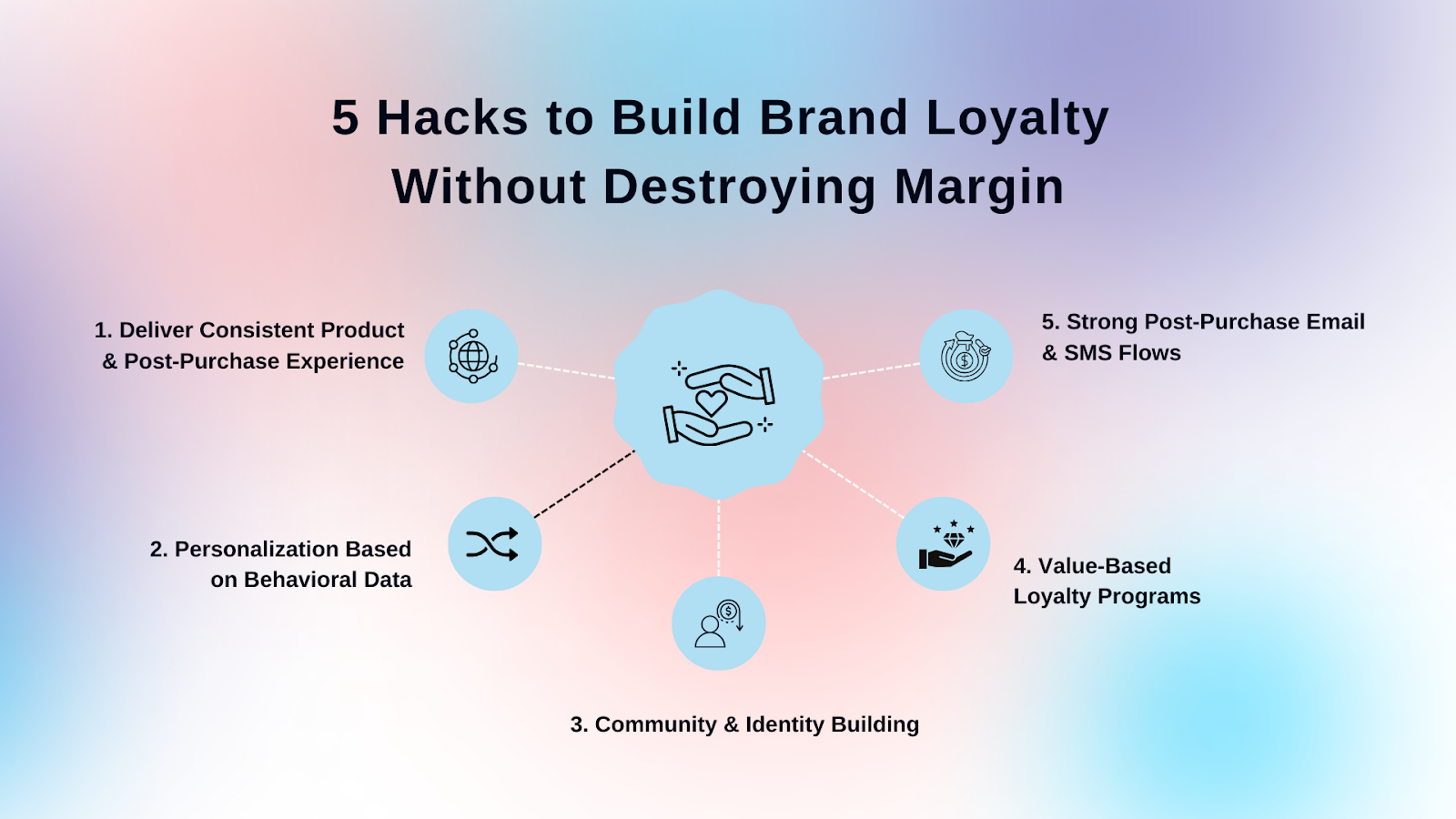
Building loyalty does not mean giving away margin. In fact, the strongest loyalty strategies protect profit instead of eroding it. The key is to focus on experience, data, and identity, not constant discounts.
Here’s how to do it in a practical, e-commerce-friendly way.
Deliver Consistent Product & Post-Purchase Experience
Loyalty starts after the first purchase, not before.
Loyalty starts after the first purchase, not before it.
If the product quality is inconsistent, shipping is unpredictable, or returns are painful, no rewards program will fix it. Customers come back when they trust that every order will meet expectations.
Focus on reliable fulfillment, clear communication, fast support, and smooth returns.
Instead of asking, “How do we get them to buy again?” ask, “How do we make the first experience so good that buying again feels obvious?”
That shift protects your margin because you’re not relying on discounts to trigger the next purchase.
Personalization Based on Behavioral Data
Most brands collect data but don’t use it well.
Instead of sending the same promotion to everyone, segment customers by behavior, first-time buyers, high-LTV customers, churn-risk customers, and so on. Recommend products based on past purchases, browsing patterns, or replenishment timing.
For example, if someone buys skincare every 60 days, your messaging should match that cycle. If a customer consistently buys premium items, showing entry-level products may feel off-brand.
When customers feel understood, conversion rates increase and unnecessary discounting decreases. Personalization improves revenue per customer without increasing cost per acquisition.
Community & Identity Building
Emotional loyalty is built when customers feel connected to something bigger than the product.
This could mean user-generated content, private groups, ambassador programs, or simply consistent storytelling around shared values. When customers identify with your brand, they become advocates, not just buyers.
Community reduces price sensitivity and strengthens retention because customers are staying for belonging, not just utility.
Value-Based Loyalty Programs (Not Just Points)
A points program alone rarely creates real loyalty. If customers only engage when rewards are high, the program becomes a margin drain.
Instead, design programs around value. Offer early access to launches, exclusive products, content, or status recognition. Tiered systems work well when perks feel meaningful rather than purely transactional.
The goal is to reward engagement and identity, not just spending volume.
Strong Post-Purchase Email & SMS Flows
Many brands invest heavily in acquisition but neglect post-purchase communication.
Use email and SMS to guide customers through onboarding, education, cross-sells, and replenishment reminders. Ask for reviews, share product tips, and introduce complementary items at the right time.
When post-purchase flows are strategic instead of promotional, they increase repeat purchases and lifetime value without constant discount pressure.
Why Many Ecommerce Loyalty Strategies Fail
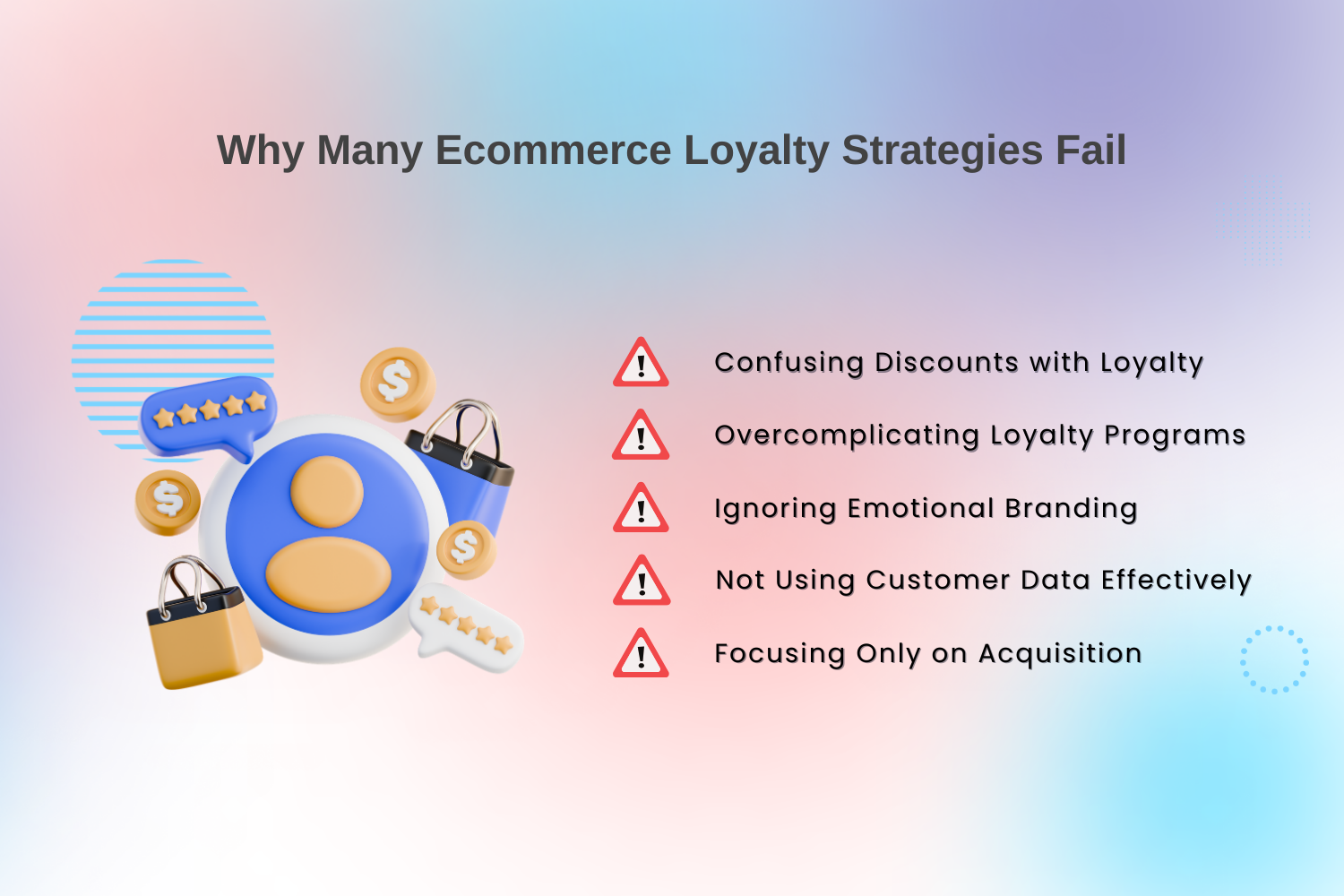
Now let’s talk about why so many loyalty efforts don’t work. Understanding these mistakes helps you avoid wasting time and margin.
Confusing Discounts with Loyalty
Discounts drive transactions, not attachment.
If your retention strategy depends on running sales every month, you are training customers to wait for promotions. Over time, this weakens margins and reduces brand perception.
Loyalty should reduce discount dependency, not increase it.
Overcomplicating Loyalty Programs
Some programs become so complex that customers don’t understand how to benefit from them.
If tiers, points, and conditions feel confusing, engagement drops. A simple, clear structure almost always performs better than an elaborate one that no one uses.
Clarity builds participation. Complexity kills it.
Ignoring Emotional Branding
Brands that focus only on performance marketing often neglect storytelling and identity.
Emotional branding isn’t about being dramatic. It’s about clarity. What do you stand for? Who is this brand for? Why does it exist beyond selling products?
When that answer is strong, loyalty becomes much easier to build.
Not Using Customer Data Effectively
Many e-commerce brands have rich data, but treat all customers the same.
If you’re not segmenting customers by behavior, frequency, and lifetime value, your communication will feel generic. Generic messaging leads to average engagement, and average engagement limits loyalty.
Smart data usage allows you to reward loyalty strategically instead of broadly discounting.
Focusing Only on Acquisition
When growth targets are aggressive, teams default to more ads.
But if acquisition keeps increasing while retention stays flat, profitability becomes fragile.
The brands that win long term shift from acquisition-first thinking to lifetime value thinking. They still acquire customers, but they design the entire system to maximize what happens after the first purchase.
Brand loyalty is not created through a single tactic. It’s built through consistent experience, smart data use, emotional connection, and margin-conscious strategy. When done correctly, loyalty strengthens your economics rather than weakening them.
Final Thoughts: Loyalty Is a Growth Multiplier, Not Just a Marketing Tactic
It’s easy to treat loyalty as a campaign. Launch a points program. Send a few retention emails. Run a VIP sale. Then move on.
But real brand loyalty is not a tactic. It’s a strategic asset.
When loyalty is strong, every part of your business performs better.
- Acquisition becomes more efficient because the lifetime value is higher.
- Margins improve because customers are less price-sensitive.
- New products launch faster because you already have trust.
- Revenue becomes more stable because repeat purchases create a predictable base.
That’s why loyalty works as a growth multiplier.
A retention-first growth model doesn’t mean you stop acquiring customers. It means you design the business so that every new customer becomes more valuable over time.
Instead of constantly chasing new traffic to hit revenue targets, you build a system where past customers fuel future growth.
Short-term ads can generate spikes. Loyalty builds compounding advantage.
And in e-commerce, compounding always wins.
FAQs
What are the main benefits of brand loyalty?
The main benefits include higher customer lifetime value, lower effective acquisition costs, stronger pricing power, larger average order values, and more stable revenue.
Loyal customers buy more often, spend more over time, and are less sensitive to discounts. That combination directly improves profitability and predictability.
How does brand loyalty increase profits?
Brand loyalty increases profits by improving retention and reducing margin pressure.
When customers return without heavy incentives, you spend less on reacquisition and protect your pricing. Higher lifetime value and lower discount dependency together create healthier margins and better cash flow.
Is brand loyalty more important than customer acquisition?
Both matter, but acquisition without retention is fragile.
If customers do not come back, you are forced to keep spending to replace them. Loyalty ensures that acquisition investments compound over time instead of resetting after every purchase.
In that sense, loyalty protects and multiplies your acquisition efforts.
How long does it take to build brand loyalty?
Loyalty does not happen overnight. Transactional repeat purchases can happen quickly, but emotional loyalty takes consistent experience, communication, and brand clarity.
Most brands start seeing measurable retention improvements within months, while deeper loyalty builds over years of consistent delivery.
Can small ecommerce brands build brand loyalty?
Yes, and often more easily than large brands.
Smaller brands can offer more personal communication, clearer identity, and stronger community connection. When executed well, this creates emotional attachment that larger competitors struggle to replicate.
What’s the difference between brand loyalty and brand awareness?
Brand awareness means people recognize your name. Brand loyalty means people prefer you and continue buying from you.
Awareness helps you get noticed. Loyalty helps you stay profitable.
A brand can be well known but still lose customers if loyalty is weak.

Written by
Thomas Nguyen is the CTO of Joy, a loyalty solution for Shopify and eCommerce brands. With years of experience building high-performance Shopify apps, Thomas aims to help merchants grow through customizable and retention-focused tools.
Related reading
 How-to Guide
How To Calculate and Improve Your Loyalty Program ROI
From measuring ROI to optimizing rewards and reducing churn, this guide reveals practical strategies and key metrics to turn your loyalty program into a profitable growth engine.
 Thomas Nguyen
 How-to Guide
7 Types Of Customer Loyalty & How to Strengthen Them
Explore seven types of customer loyalty and learn effective strategies to boost retention and long-term success. Enhance your loyalty program and strengthen customer connections today!
Thomas Nguyen How-to Guide
Brand Loyalty Statistics: The 2026 Profitability Guide
Facebook CAC jumped 295% in a year. Allbirds got 1700% ROI from loyalty. This 2026 brand loyalty statistics guide unpacks the benchmarks that separate profitable retention from expensive acquisition — plus the redemption rates, LTV math, and Gen Z data behind today's top programs.
Thomas Nguyen How-to Guide
Brand Extension vs Brand Loyalty: How Ecommerce Brands Should Decide When to Grow
Most ecommerce owners think more products mean more revenue. But they confuse brand extension with brand loyalty, and that confusion quietly drains their margins.
Thomas Nguyen How-to Guide
An Ultimate Guide To Loyalty Points: How To Calculate Point Value
Curious how loyalty points are valued? Learn how to calculate their true worth and create a rewards system that boosts customer engagement and profitability.
Thomas Nguyen How-to Guide
Brand Loyalty Meaning: Definition, Examples & Ecommerce Strategy Guide 2026
Confused about the meaning of brand loyalty? It's that magic where buyers pick you every time. Check simple ways top brands use to turn shoppers into fans and grow their business.
Thomas Nguyen