
Brand Extension vs Brand Loyalty: How Ecommerce Brands Should Decide When to Grow
Most ecommerce owners think more products mean more revenue. But they confuse brand extension with brand loyalty, and that confusion quietly drains their margins.
Summarize this post with AI
Most e-commerce owners think that if they want more money, they need more products.
They launch new items, spend thousands on ads, and then wonder why their bank account still looks empty.
The truth?
They are mixing up Brand Extension and Brand Loyalty. One helps you grow, but the other keeps you profitable.
If you don't know the difference, you might be building a house on sand.
Let’s dive into which one actually saves your business.
Quick Answer: Brand Extension vs. Brand Loyalty
Before going deeper, here’s the fast comparison. These are the 3 core differences that matter for ecommerce strategy.
Here’s the clear conclusion: Brand extension and brand loyalty solve 2 different growth problems.
Brand extension is about expansion. It focuses on adding new products to reach new customers and increase revenue from a broader catalog. The result is more SKUs and a wider market reach.
Brand loyalty is about retention. It focuses on keeping existing customers satisfied through better service, experience, and rewards. The result is customers who stay longer and generate predictable, repeat revenue.
In short:
- Brand extension increases what you sell.
- Brand loyalty increases how often and for how long people buy from you.
The smartest ecommerce brands understand that extension increases what you sell, but loyalty determines how long customers stay. And that long-term stability often matters more than short-term expansion.
Why E-commerce Brands Confuse These Two (And Why It Costs Them)
In theory, the distinction between brand extension and brand loyalty is clear. In practice, many ecommerce companies mix them up, often unintentionally.
The confusion usually stems from the pressure modern digital brands face to grow.
The pressure usually starts with growth expectations. As revenue targets rise, brands launch more SKUs or enter adjacent categories rather than strengthening their core customer relationships. Expanding the catalog looks like progress, but it often masks a fragile retention system.
In reality, the economics of ecommerce favor retention. According to Bain & Company, increasing customer retention by 5% can raise profits by 25–95% because loyal customers purchase more frequently and require less acquisition spending.
When retention is weak, brands sometimes try category expansion as a substitute. The logic is simple: if customers are not buying again, offer them something new. But this treats the symptom, not the cause.
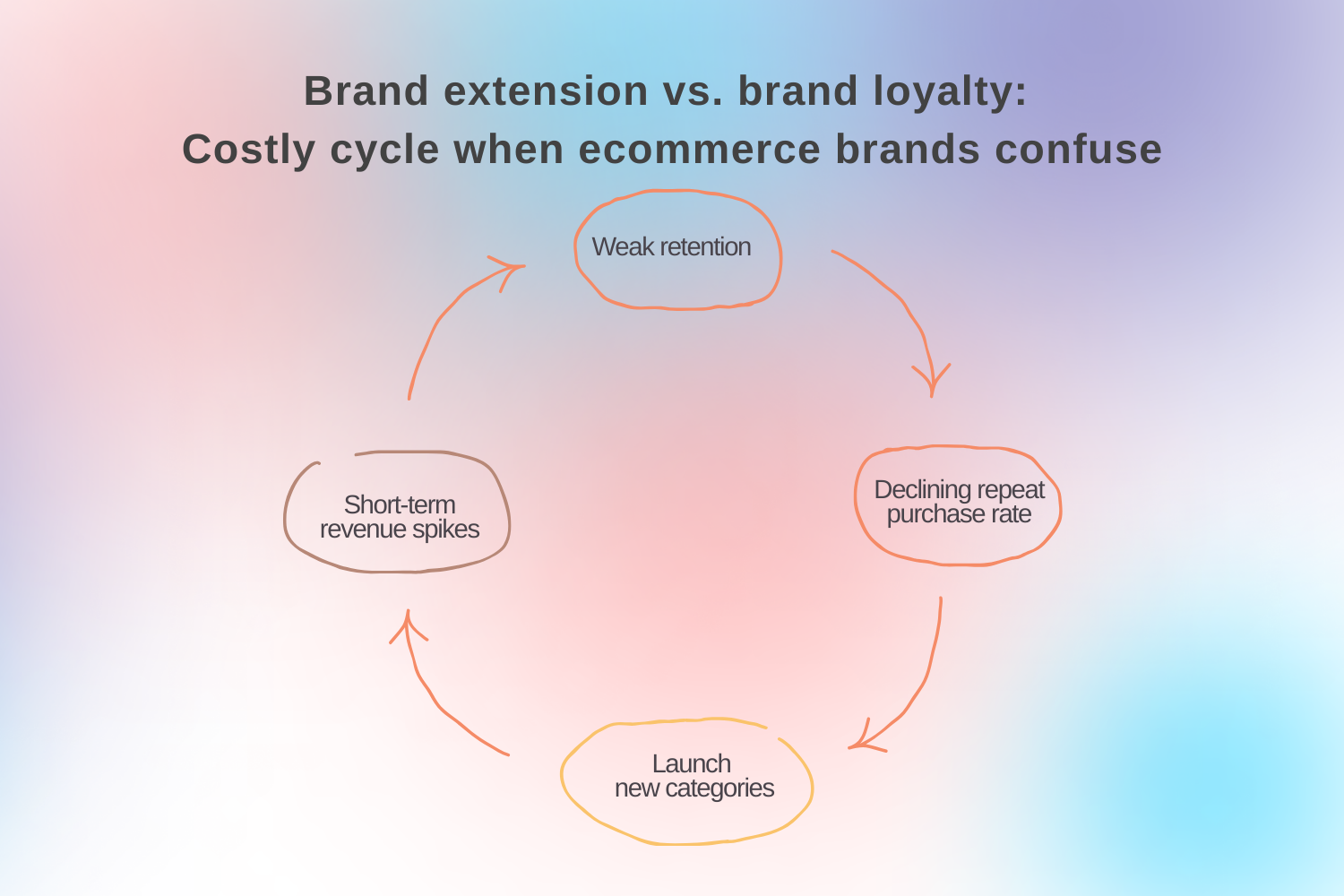
The result is a common but costly cycle:
- Weak retention → declining repeat purchase rate
- Launch new categories → short-term revenue spikes
- Customer loyalty remains unchanged
Before launching anything new, you need to decide what problem you’re actually solving.
That’s where a clear decision framework becomes essential. Now, let’s walk through a simple framework to decide.
A Decision Framework: Extend the Brand or Reinforce Customer Loyalty?
When growth slows, the pressure to “do something” gets loud. Launching a new product feels exciting. Improving retention feels quieter, less visible, and sometimes less glamorous.
But this decision shouldn’t be emotional. It should be diagnostic.
Here’s a simple framework you can use before committing to budget, inventory, and team focus.
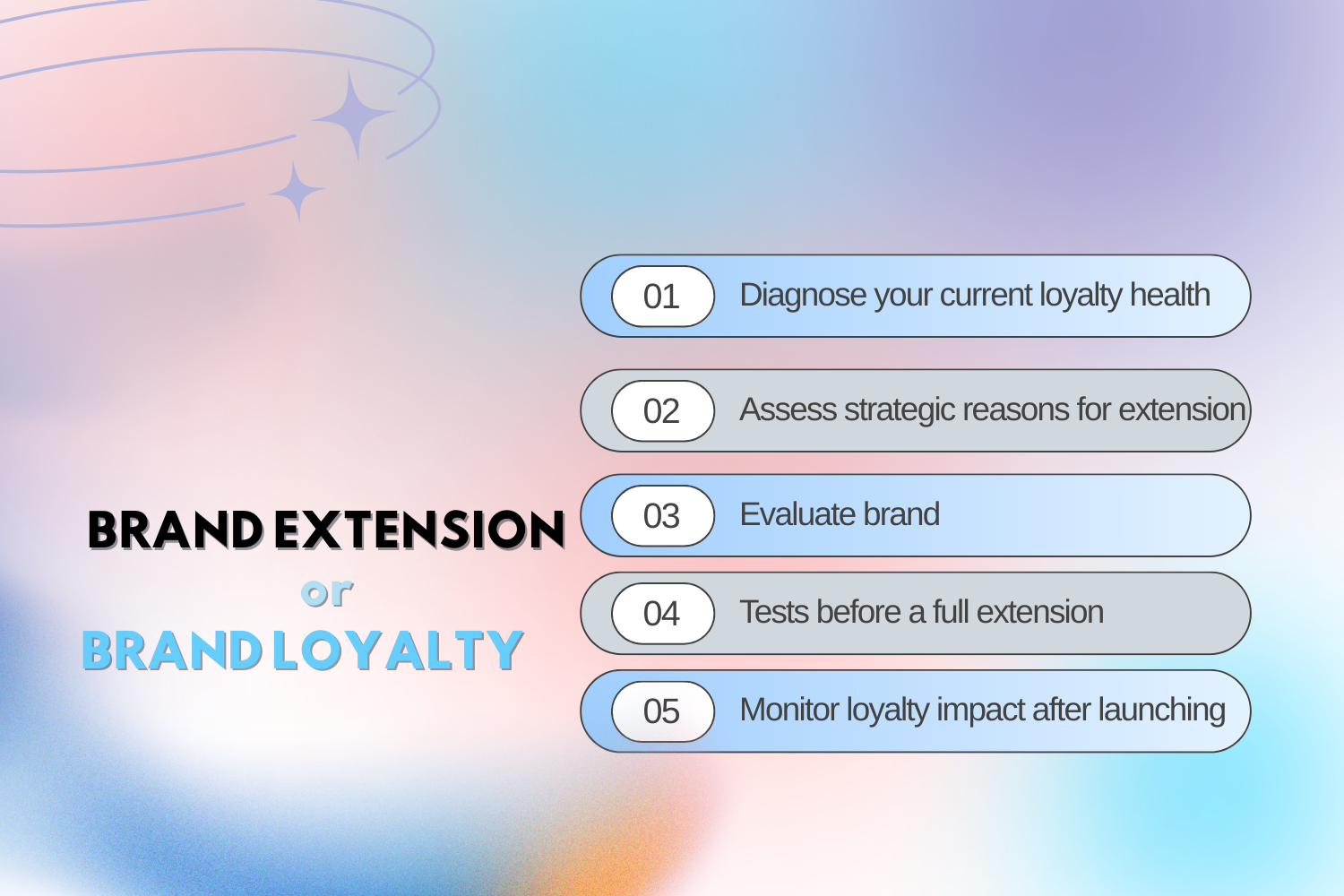
Step 1: Diagnose Your Current Loyalty Health
Before you add more products, make sure your foundation is solid. Look at your dashboard and check these three things:
How to interpret this:
- Two or more healthy signals → Your loyalty foundation is relatively stable.
- One or zero healthy signals → Focus on fixing retention before expanding.
If customers are not returning regularly, launching new products rarely solves the real problem. It simply increases operational complexity without improving customer behavior.
Step 2: Assess Strategic Reasons for an Extension
If your loyalty numbers are great, it might be time to grow. Ask yourself if you are hitting a "growth ceiling" where you can't find any more new customers for your main product.
Even brands with strong loyalty do not always need extensions. Ask yourself if you are hitting a "growth ceiling" where you can't find any more new customers for your main product.
Signals that a brand may be reaching a growth ceiling include:
- Customer acquisition costs are rising while conversion rates remain stable
- Returning customers are already purchasing most of the existing catalog
- Average order value plateauing despite promotions or bundles
At this stage, adding adjacent products can unlock new revenue from the same loyal audience rather than relying purely on new customer acquisition.
Step 3: Evaluate Brand - Product Fit
Not every new category strengthens the brand. Poorly aligned extensions often confuse customers and dilute positioning.
A quick brand-fit checklist helps reduce this risk:
- Does the new product reinforce the core brand promise?
- Will it make the brand’s value proposition clearer or more confusing?
- Is there a natural narrative linking the existing product to the new one?
For example, Glossier expanded from skincare into makeup only after building strong credibility around beauty routines and a customer community. The extension felt like a natural continuation rather than a random product launch.
Step 4: Run Small Tests Before a Full Extension
Don't spend thousands of dollars on a huge launch without proof. Start by sending a pre-launch survey or a "coming soon" waitlist to your best customers.
You can also try a limited drop or a small bundle only for your most loyal fans to see if they actually hit the "buy" button. Use simple landing pages and email flows to test interest before you sign a massive contract with a new supplier.
These tests reveal whether real customers want the new product, rather than relying purely on internal assumptions.
Step 5: Monitor Loyalty Impact After Launching
Once the new product is live, keep a very close eye on the data. You want to make sure the "new stuff" isn't hurting your "old stuff."
Watch your Average Order Value (AOV) to see if people are buying both items together. Keep an eye on your support tickets for any signs of confusion or disappointment from your long-time fans. If your original products start selling less, your extension might be "eating" your core business.
Practical Examples of Brand Extension and Loyalty in E-commerce
These scenarios aren’t just about theory. They reflect the real strategic choices e-commerce brands face every day. You often have to decide: should I expand my product line or deepen my customer relationships?
Example 1 – Strong Loyalty Makes Brand Extension Work
This example shows how brand loyalty actually reduces the risk of a brand extension. When people already love you, they are much more willing to try your "new thing."
Imagine a specialty coffee roaster with a massive following of "superfans" who buy their beans every month. Because these customers trust the brand's taste, the roaster successfully launched a line of high-end ceramic mugs and travel brewers. They didn't have to spend a dollar on ads to sell out the first batch.
Their loyal subscribers were waiting in line to buy whatever the brand released next. The trust was already there, so the new category felt like a natural gift to the community.
What this proves: Extension performs best when loyalty is already strong. Your fans become your most effective launch team.
Example 2 – Brand Extension Without Loyalty Backfires
This example shows what happens when a brand tries to extend before strengthening its connection with customers. Without a foundation of trust, a new product can feel like a "cash grab."
Think of a fast-fashion brand that grew quickly by selling cheap, trendy dresses through Instagram ads. Most of their customers were "one-and-done" buyers who only cared about the lowest price. When the brand tried to launch a premium leather handbag line, it completely flopped.
The customers didn't have enough loyalty to believe the brand could make high-quality leather. Since there was no emotional connection, people just went to a dedicated bag store instead.
What this proves: Weak loyalty amplifies extension risk. If people don't care about your brand, they won't follow you into a new category.
Example 3 – Choosing Loyalty Over Extension (And Winning)
This example shows when doubling down on loyalty is actually smarter than expanding your categories. Sometimes, the best way to grow is to stop looking for "new" and start looking "deeper."
Consider a skincare brand that sold one perfect, high-performing face oil. Instead of rushing to launch soaps, cleansers, and towels, they focused entirely on retention. They built a VIP community where customers could talk to dermatologists and get personalized skin coaching.
They also started a "Refill and Save" subscription that felt like an exclusive club for "insiders." Because they focused on the relationship, their repeat purchase rate tripled in six months without adding a single new SKU.
What this proves: Sometimes the highest ROI move is deeper retention, not more products. You don't always need a bigger catalog to build a bigger business.
Conclusion
To sum it up, brand extension is about growing your catalog, while brand loyalty is about growing your relationships. One adds more products to your shop; the other adds more value to your customers.
The most important rule is this: Don’t extend until you have built a solid base of loyal fans and a clear brand promise. If you launch new things before people trust your old things, you risk losing everything. Take a moment to run your own store through the decision checklist we discussed. It will help you decide whether to build "wider" with new items or "deeper" with better service.
FAQ: Brand Extension and Brand Loyalty
What is the main difference between brand extension and brand loyalty?
The main difference is your focus. An extension is a growth strategy where you use your name to sell new types of products. Loyalty is a retention strategy where you make sure your current customers keep coming back to buy from you.
Can brand extension increase brand loyalty?
Yes, it definitely can! If you launch a new product that your fans really need, it makes them love your brand even more. It shows you are listening to them and helping them solve more problems in their lives.
When should a small e-commerce brand consider a brand extension?
You should consider it once your "hero" product is stable and selling well. If you have extra budget and your current customers are asking for something new, it might be time. Just make sure your team can handle the extra shipping and support work.
How do I know if my brand is ready to extend into a new category?
Check your data first. If your Repeat Purchase Rate is healthy (above 20%) and your reviews are great, you have a strong foundation. If people are already asking "When are you going to sell [New Product]?", that is a huge green light.
Can a bad brand extension destroy customer loyalty?
Sadly, yes. If you launch a low-quality product that doesn't fit your brand, your loyal fans might feel "betrayed." They might stop buying your original products because they no longer trust your quality or your vision.
Is it better to focus on loyalty or product expansion first?
Always focus on loyalty first. It is much easier and cheaper to grow a business when you have a group of fans who support you. Once they are happy, they will practically "pull" you into new categories by asking for more products.

Written by
Thomas Nguyen is the CTO of Joy, a loyalty solution for Shopify and eCommerce brands. With years of experience building high-performance Shopify apps, Thomas aims to help merchants grow through customizable and retention-focused tools.
Related reading
 How-to Guide
Building Brand Loyalty for Ecommerce Brands in 2026: A Complete Playbook
Building brand loyalty is how smart ecommerce brands grow without chasing ads. Learn simple ways to turn buyers into repeat fans.
 Thomas Nguyen
 How-to Guide
Benefits of Brand Loyalty: Why It’s the Most Profitable Growth Lever for Ecommerce Brands
Want stronger retention and higher margins? Learn the true benefits of brand loyalty and how it drives long-term ecommerce growth.
Thomas Nguyen How-to Guide
7 Types Of Customer Loyalty & How to Strengthen Them
Explore seven types of customer loyalty and learn effective strategies to boost retention and long-term success. Enhance your loyalty program and strengthen customer connections today!
Thomas Nguyen-4b0e2f.webp&w=3840&q=75) How-to Guide
How-to GuideReferral Partner Program: A 6-Step Guide to Real Revenue
A practical guide to building a referral partner program: how it differs from customer referrals, a 6-step setup, commission models, the metrics that matter, and why most stall.
Thomas Nguyen How-to Guide
How to Measure Brand Loyalty: 6 Critical Metrics for 2026
Likes don't equal loyalty - and neither do single-purchase sales. This guide breaks down how to measure brand loyalty with 6 critical metrics: LTV, repeat purchase rate, retention rate, point redemption, NPS, and UGC. Plus benchmarks for 2026 - when acquisition costs are 4× higher.
Thomas Nguyen How-to Guide
Brand Loyalty Questionnaire: 9 Strategic Steps for 2026
Likes don't reveal why customers stay. A brand loyalty questionnaire does. This guide breaks down 9 strategic steps to design, distribute, and act on surveys — from NPS and CSAT setup to automated follow-ups — so you can stop guessing and start retaining at lower acquisition costs.
Thomas Nguyen