American Airlines Loyalty program: $30B secret + Retention tricks
The American Airlines loyalty program is a $30B engine, not a perk. See how AAdvantage turns points into status, partners, and a retention flywheel you can copy.
Summarize this post with AI
The American Airlines loyalty program isn't just for flyers; it's a multi-billion-dollar powerhouse that ecommerce brands must copy.
Forget free flights. AAdvantage turns points into a habit-forming empire, locking customers in with status, partners, and unbreakable flywheels. And Elites demonstrate significantly higher repeat behavior and share of wallet.
In 2026, as your cart abandonment hits 70%, steal these airline secrets to make loyalty your top profit driver.
Ready to build an ecosystem that pays you back? Scroll to learn how.
How the American Airlines Loyalty Program Works (The Multi-Billion Dollar Engine)
To understand the scale, one must look at the balance sheet.
In 2020, during pandemic financing, American Airlines disclosed an internal valuation range for AAdvantage in the roughly $18B–$30B range.
For context, this valuation often exceeds the market capitalization of the airline's physical flight operations. AAdvantage isn't just a "perk"; it is the most valuable part of the company.
Let's now uncover the secrets that enable AAdvantage Engine to generate a $30 billion asset.
The Core Currency: Miles vs. Loyalty Points
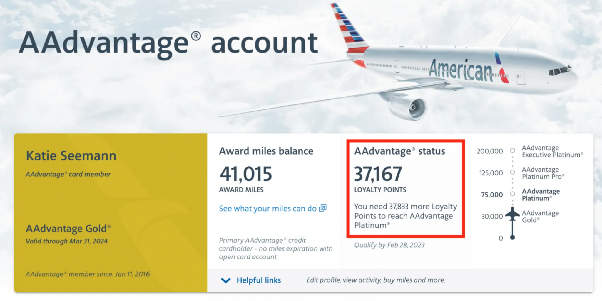
AAdvantage operates a dual-currency system built on two kinds of loyalty points:
- Miles: Redeemable currency for flights, upgrades, and partner rewards
- Loyalty Points: Status-qualifying metric determining elite tier access
Miles drive long-term aspiration. Loyalty Points drive immediate behavioral alignment.
By tying status directly to earning (including non-flight activities), AA incentivizes users to use their co-branded credit cards for every purchase, not just travel. This ensures that even when a customer isn't flying, AA continues to collect data and transaction fees.
Status Tiers and the Benefits Ladder
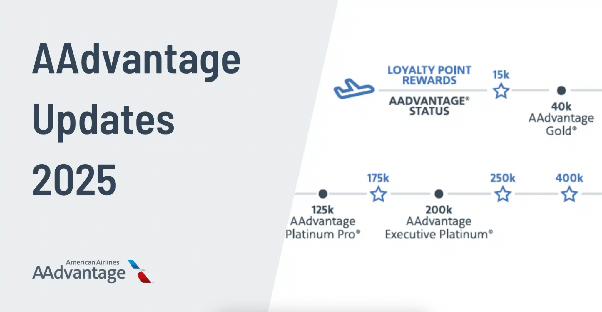
AAdvantage uses tiered status levels (Gold, Platinum, Executive Platinum, etc.) to create visible progression. Each tier unlocks incremental privileges: upgrades, priority boarding, lounge access, and bonus earning rates.
By showing a member they are only "2,000 LPs away from Platinum," AA triggers the Goal Gradient Effect, the tendency for users to accelerate their spending as they get closer to a milestone.
The ladder creates aspiration. It converts transactional behavior into identity-based motivation. Once a traveler approaches a higher tier, switching airlines becomes psychologically costly.
Retention is engineered through progress visibility.
Everyday Earning: Partners and Non-Flight Touchpoints
The most powerful component of the engine is the AAdvantage eShopping portal and its network of 1,200+ retail partners. Members can earn miles and Loyalty Points not just by flying, but through everyday spending on shopping, dining, and other routine activities.
For instance, buying a vacuum from Dyson.com via the AA portal could earn 10x miles and the same number of Loyalty Points toward elite status.
This also allows AA to track consumer behavior far outside the airport. They know what you buy, where you shop, and how often you travel, allowing for hyper-personalized marketing.
By embedding the AAdvantage "engine" into daily life, from the morning coffee to the monthly utility bill, American Airlines has ensured that it is the first brand a consumer thinks of, even before they’ve booked a trip.
The Business Model Behind AAdvantage
The brilliance of AAdvantage lies in its B2B2C monetization model. American Airlines is essentially a central bank that prints its own currency and sells it to third parties.
Loyalty as a Revenue Engine (Not a Cost Center)
Airline loyalty economics operate differently from most e-commerce programs.
American Airlines sells billions of miles annually to banks that issue co-branded credit cards. Banks purchase miles upfront and use them as incentives to drive card acquisition and spending.
For the airline, those mile sales generate high-margin cash flow long before any flight is redeemed.
Accounting mechanics further enhance the model:
- Miles issued become deferred liabilities
- Redemption occurs over time
- Some miles expire unused (breakage)
Breakage improves profitability. Deferred accounting smooths earnings. The program generates revenue even before transportation services are delivered.
Loyalty, in this structure, resembles a financial product.
The Credit Card Powerhouse
Co-branded cards convert miles into cash.
Cardholders earn miles on everyday purchases, not just flights. The more they spend, the more miles they accumulate.
Banks benefit from transaction fees and interest revenue. The airline benefits from mile sales and increased brand dependency.
This creates a recurring engagement loop:
Spend → Earn miles → Increase attachment → Book flights → Reinforce card usage.
The loyalty program becomes a bridge between travel and personal finance.
And the evidence is that in 2023, American Airlines generated over $5.2 billion in cash flow from its loyalty program and partner agreements.
For e-commerce brands, this is the clearest signal: partnerships can monetize loyalty beyond core product margins.
The Flywheel Effect: Designing Economic Gravity
The AAdvantage loop can be simplified as:
Earn → Status → Perks → Brand lock-in → More spend
Each layer strengthens the next. As members accumulate miles, they pursue higher status. As status rises, switching costs increase. As switching costs increase, spending consolidates.
The flywheel compounds at scale.
Importantly, the airline does not rely solely on emotional storytelling. It reinforces habit through the combined effects of economic and identity incentives.
Behavioral Psychology: Why AAdvantage Creates Deep Engagement
Why do people chase "Executive Platinum" status with the same fervor gamers chase high scores? Because AA has mastered the architecture of human motivation.
Status as Instant Emotional Currency
In the AAdvantage world, Status is Identity. It’s not about the points; it’s about who you are at the airport.
When a member sees "Group 1 Boarding" on their pass, it’s a public signal of success. E-commerce brands can replicate this by offering "Founding Member" badges or "Inner Circle" access that provides social proof, not just discounts.
Tiered status functions as identity signaling. Members are not simply travelers; they are Gold or Executive Platinum.
Soft Landing & Retention Safeguards
AA rarely lets a high-value customer drop from "Hero to Zero" in one year.
If a member fails to requalify for Executive Platinum, they don't drop to zero; they "soft land" into Platinum. This prevents the "churn shock" of losing all benefits at once.
The lesson for e-commerce: If a VIP’s spending dips, don't delete their perks—give them a "re-engagement challenge" to win them back.
Miles as Long-Term Behavioral Glue
Unlike an instant 10% coupon, miles require "saving." This forces the customer into a long-term relationship. The longer they save, the more "invested" they become in your brand.
By varying the "cost" of rewards, AA creates a "treasure hunt" effect.
Members check the app daily to see if their dream flight is "on sale" for miles, creating a high-frequency digital habit.
Breakage economics add another behavioral lever.
When miles are near expiration, it triggers a "loss aversion" response. Customers often make small, unnecessary purchases just to keep their balance active.
Key Takeaway for E-commerce: Are you giving away margin through discounts that are forgotten tomorrow? Or are you building a "currency" that stays in your customer's wallet and mind for years?
4 Strategic Lessons E-commerce Brands Should Apply
The American Airlines loyalty program isn't successful because it gives away "free stuff." It is successful because it has mastered the mathematics of human behavior.
Here is how you can translate airline-scale logic into your e-commerce growth strategy.
Build Ecosystems, Not Isolated Programs
American Airlines doesn't just reward you for flying; they reward you for living. By partnering with Shell, Hyatt, and Uber, they ensure the AAdvantage brand is present in your wallet even when you aren't at the airport.
Stop thinking about your loyalty program as a "points for purchases" calculator on your checkout page.
E-commerce brands can replicate this principle through brand partnerships, marketplaces, or cross-category alliances.
Let’s form a "Non-Competitive Alliances" and increase your Surface Area. If you sell high-end cookware, partner with a premium olive oil subscription or a kitchenware insurance provider.
The more places a customer can earn or use your "currency," the more indispensable your brand becomes to their lifestyle.
Make Status Visible
Status visibility turns passive loyalty into active obsession, because people chase what they can see.
Customers within 10% of the next status tier are 50% more likely to make an incremental purchase to "close the gap."
In airlines, status shines everywhere: "Group 1 boarding!" or shiny luggage tags. Everyone sees it. It's a badge of pride.
But in e-commerce? Status is hidden on the "My Account" page that customers ignore.
Fix it simply: Put status front and center. Add a progress bar right in the shopping cart or homepage dashboard.
Example: A beauty brand adds a cart bar: "85% to VIP - unlock free samples." Customers feel the excitement and buy.
When people see their VIP status, they share your brand with friends 3x more often. Visible status really turns shoppers into fans.
Design for Accumulation
Most e-commerce loyalty programs are "burn-focused": spend $100, get $5 off immediately. This is a transaction, not a relationship.
American Airlines plays the long game by skipping instant discounts. They focus on building up rewards over time—like saving miles for a dream trip. Once customers have a big pile of miles, switching airlines feels too hard. And they stay loyal.
How can you do this in e-commerce? Swap flat rewards for "milestone goals."
Simple example:
Not "5% back on every buy."
But: "Hit $1,000 spend this year → Get a free 1-on-1 styling session + free shipping forever!"
This creates excitement. Customers keep coming back to "unlock" the prize.
Proof: Quick discounts boost one sale. Accumulation keeps customers for years, which lifts retention by 25-40% (like AA elites).
Engineer a Retention Flywheel
A loyalty program should not be a straight line (Start → Finish).
It should be a loop:
Earn → Unlock → Reinforce → Repeat
Each action should push the customer toward the next one.
One effective tactic is using triggered accelerators.
- When a customer earns points, send a message: “You’re 20% away from your next reward.”
- When they redeem a reward, immediately give a small bonus to restart momentum.
This keeps progress visible and motivation high.
The biggest challenge is getting started, especially with new customers who have no points yet. But smart triggers fix that: automated emails, app notifications, or cart reminders that spark the first spin.
And once customers enter the loop, habit and anticipation take over. Then your well-designed flywheel eventually runs on its own.
Case Scenarios: AAdvantage Patterns Reimagined for E-commerce
Theory is great, but execution is better. To truly understand the "AAdvantage Effect," we have to examine how these airline mechanics translate across different e-commerce verticals.
Whether you sell $5,000 sofas or $15 lipsticks, there is a structural blueprint you can steal.
Low-Frequency, High-Margin Brand (Furniture, Luxury)
In luxury, customers don't buy every week. If you wait for the next transaction to reward them, they’ll have forgotten you exist by the time they need a new dining table.
Here, we use the "Million Miler" strategy: lifetime recognition that transcends individual transactions.
Structure:
- Tier 1: $5,000 lifetime spend → Private sale access
- Tier 2: $15,000 → Dedicated advisor
- Tier 3: $50,000 → Invitation-only collections
Don't focus on points that are about to expire. Focus on Prestige and Progression. Just as an airline grants "Lifetime Status" to its most frequent flyers, a luxury brand should reward its most loyal customers.
High-Frequency, Low-Margin Brand (Beauty, FMCG)
In FMCG (Fast-Moving Consumer Goods), the battle is won in the daily habit.
This is the "Short-Haul Commuter" strategy. It’s about micro-rewards and constant dopamine hits to ensure the customer doesn't "cheat" on your brand with a competitor.
Structure:
- 1 point per $1
- 200 points = $5 reward
- Monthly streak multipliers
- Quarterly tier accelerators
Emphasize everyday earnings and micro-rewards. Introduce smaller but frequent reinforcement cycles.
Here, habit outweighs aspiration.
Marketplace or Multi-Brand Retailer
If you sell products from many vendors, you can build an “alliance ecosystem”. You are not just one store; you become the shared currency across many brands.
Keep the structure simple and powerful:
- Cross-brand earning: Points add up no matter which brand they buy from.
- Shared rewards: Use points from Brand A to get deals on Brand B.
- Network perks: Gold status means free shipping everywhere in your marketplace, from any vendor.
This creates "network magic": the more brands you connect, the more valuable your points become, pulling customers deeper into your world.
Suddenly, leaving for a single-brand rival feels impossible if they have $50 in unused credits waiting.
Even better, you see customer behavior across categories, not just one brand. This allows more personalized marketing than a single-brand store can offer.
Conclusion
Loyalty is not about giving points. It is about designing economic gravity.
The system behind the American Airlines loyalty program demonstrates that loyalty can function as:
- A revenue engine
- A behavioral architecture
- A data compounding system
- A balance-sheet asset
The brands that understand this will not compete on discounts.
They will compete on ecosystems, identity, and compounding retention architecture.
That is the difference between a rewards program and a loyalty engine.
FAQs
Which American Airlines has the best loyalty program?
There is only one American Airlines, and its program is AAdvantage. As of 2026, it is widely considered the most economically sophisticated airline loyalty system in North America.
While competitors like Delta (SkyMiles) focus heavily on the "on-board experience," American Airlines has won by focusing on ecosystem flexibility.
Do I need tiers for my e-commerce loyalty program?
Not necessarily. Tiers are powerful when identity and progression matter. For purely transactional categories, simpler accumulation models may perform better.
How do I avoid giving away too much margin in rewards?
Align rewards with high-margin products, supplier funding, or non-core monetization streams. Airlines offset reward costs through mile sales and breakage.
What if I’m too small to build a partner ecosystem?
Start tiny, like AA's early shopping portal, which grew to $500M in revenue.
Pick 2-3 affiliates or supplier perks, no big network needed. One ecommerce brand added a dining tie-in and saw a 20% lift in retention.
Scale slowly: Focus on data and habits first. Size doesn't block you, smart alliances do.

Written by
Thomas Nguyen is the CTO of Joy, a loyalty solution for Shopify and eCommerce brands. With years of experience building high-performance Shopify apps, Thomas aims to help merchants grow through customizable and retention-focused tools.
Related reading
 Examples & Inspiration
JCPenney Rewards Analysis 2026: The Strategic Mechanics of "CashPass"
The JCPenney rewards program turns points into a branded "CashPass" currency. See how its earn rates, stacking, and 45-day expiry are engineered to drive sales.
 Thomas Nguyen
 Examples & Inspiration
Coca-Cola Brand Loyalty: 5 Strategies E-commerce Brands Can Use to Boost Retention
Coca-Cola brand loyalty is built on emotion, consistency, and ubiquity - not discounts. See the 5 strategies behind it and how to apply them to ecommerce retention.
Thomas Nguyen Examples & Inspiration
How Nectar loyalty scheme wins loyalty 2026 (And what to copy)
What can the UK's biggest coalition program teach your store? See how the Nectar loyalty scheme turns scale, shared data, and partner funding into retention.
Thomas Nguyen Examples & Inspiration
Avis Preferred 2026 Guide: Skip the Line & Earn Free Days
The Avis loyalty program (Avis Preferred) lets you skip the counter and earn free rental days. See how the tiers, points math, and status shortcuts work in 2026.
Thomas Nguyen Examples & Inspiration
Hilton Honors 2026 Review: The Easiest Path to VIP Status?
The Hilton loyalty scheme just made elite status far easier to reach. See how Hilton Honors tiers, points sweet spots, and perks stack up for 2026 travelers.
Thomas Nguyen Examples & Inspiration
Walmart Loyalty Program Explained: 2026 Strategy Guide
Walmart's loyalty isn't a points game — it's infrastructure. See how the Walmart loyalty program turns subscription, cashback, and retail media into profit.
Thomas Nguyen