
Most e-commerce merchants begin with a loyalty point because it is the easiest loyalty model and essential when customer acquisition costs are rising. You give points for spending, customers collect them, then they redeem them for a reward.
However, the simple structure can hide weak execution, and in practice, nearly 97% of merchants fail to make the program work in lifting repeat purchases.
After helping 50+ merchants avoid these pitfalls, I keep seeing the same failure causes: complex earning rules overwhelm, transactional-only focus bores, and unattainable rewards frustrate.
In this blog, I will walk you through how to run a points program that works and how to keep customers engaged until they claim the first reward. Afterwards, we will take a deeper look at how well-known brands set earning rules and design redemption flows that customers actually use.
What Is a Loyalty Points Program?
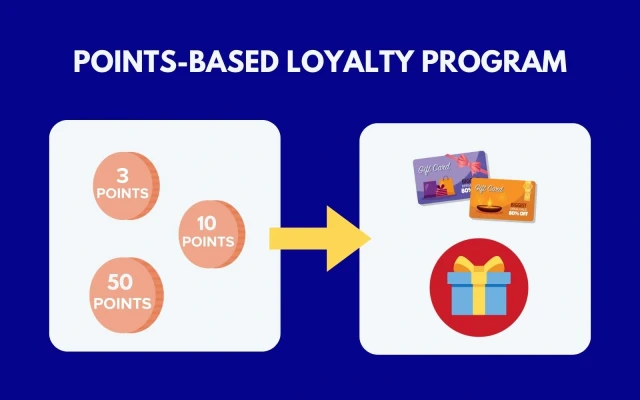
A loyalty points program is a rewards system where customers earn points for specific actions, such as making purchases, referring friends, or engaging with your brand. These points can be accumulated and redeemed for rewards like discounts, free products, exclusive perks, or other benefits.
Point-based loyalty programs are one of the most popular types of loyalty programs because they are easy to understand, customizable, and effective in encouraging long-term customer engagement.
How Does A Point-Based Loyalty Program Work?
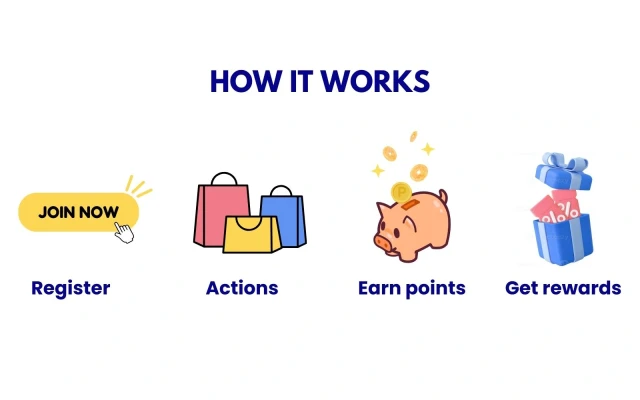
- Sign-up: Customers create an account with their information, like name and birthday.
- Earn points: Customers earn points by completing specific actions defined by the business. These can include making purchases, leaving product reviews, referring friends, engaging with the brand on social media, etc.
- Points accumulate: Points accumulate in the customer’s account and serve as a virtual reward currency. Customers can check and manage their loyalty points through a physical loyalty card, a mobile app, or an online account.
- Redeem rewards: Once enough points are collected, customers can redeem them for exciting rewards.
The loyalty program points system offers various structures, allowing store owners to choose the one that best aligns with their business model. Here are the most common types of point-based loyalty programs:
- Flat-rate programs: Customers earn a fixed number of points for every dollar spent or action taken (e.g., 1 point per $1). Simple and easy to understand, it works well for businesses with straightforward pricing.
- Action-Based Point Programs: Points are earned not just for purchases but for engaging with the brand, like leaving reviews, referring friends, signing up for newsletters, or sharing on social media.
- Tiered programs: Customers unlock higher earning rates or better rewards by reaching spending or engagement milestones. This motivates increased spending and builds long-term loyalty.
- Bonus point loyalty program: Customers earn extra points for certain actions, such as shopping during a promotional period, purchasing specific products, or reaching a milestone.
- Points-plus-cashback programs: Combine earning points with cashback loyalty program, like earning points plus 5% cashback. It appeals to customers seeking both immediate and future value.
- Gamified loyalty programs: Adds fun with game-like activities (e.g., spinning wheels or completing challenges to earn points). It enhances engagement, especially for younger audiences.
Benefits of Loyalty Points Programs
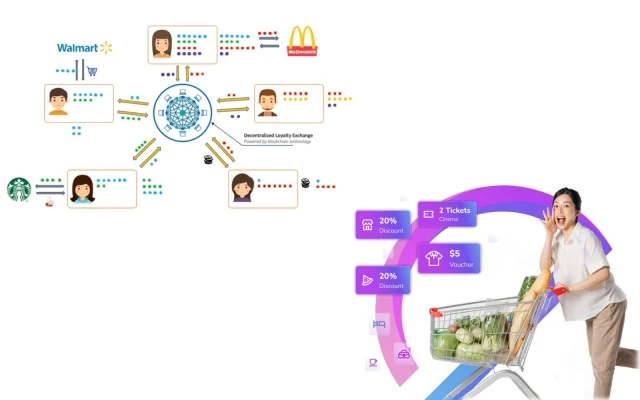
Loyalty points programs are a win-win strategy for businesses and customers.
For Businesses
- Increased customer retention: Rewarding loyalty encourages repeat purchases, reduces churn, and fosters long-term customer relationships.
- Boosted sales and revenue: Offering points motivates customers to spend more to earn rewards, often leading to higher average order values.
- Valuable customer insights: Tracking points and redemption patterns provide data on customer behavior, enabling businesses to refine marketing strategies.
- Enhanced brand loyalty: A well-designed program builds emotional connections, making customers more likely to choose your brand over competitors.
- Competitive edge: Loyalty programs differentiate a business in crowded markets, attracting new customers and retaining existing ones.
For Customers
- Enhances Customer Satisfaction: Feeling rewarded strengthens their overall experience with your brand.
- Enhanced shopping experience: Loyalty programs create a more engaging and personalized shopping experience.
- Opportunities for savings: Redeeming points helps customers save money, making frequent purchases more affordable.
- Sense of Value and Appreciation: Earning points and receiving rewards make customers feel valued and appreciated, fostering a positive emotional connection with your brand.
5 Examples of Successful Point-Based Programs
Let’s take a look at 5 successful brands with their point-based loyalty programs to discover what secrets make them so effective.
1. Starbucks Rewards
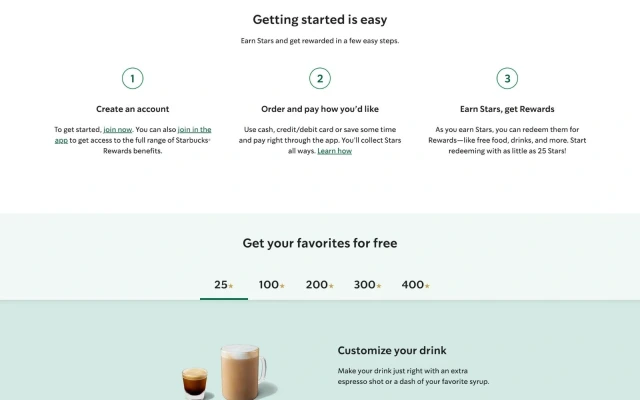
Starbucks, a global coffeehouse leader, has achieved remarkable success through its Starbucks Rewards program, which contributed to over 50% of U.S. store revenue in 2023.
By rewarding loyal customers with Stars redeemable for free drinks and exclusive perks, the program has driven both customer engagement and repeat purchases.
Members earn 1 Star per $1 spent when paying with a credit card and 2 Stars per $1 when using the Starbucks app or a Starbucks Card. Stars can be redeemed for free items, such as drinks, food, and merchandise, starting at 25 Stars. Customizations, like an extra shot of espresso, are also available for redemption.
Unique features:
- Tiered rewards for different Star levels.
- Birthday rewards for free items.
- The Starbucks app allows for seamless payment, point tracking, and reward redemption.
FnB merchants takeaway:
- Prioritize emotional perks over only transactional discounts (for example: birthday or anniversary rewards, etc.)
- Make tier status visible and a bit more challenging, inspire buyers keep their progress
- Choose rewards that match how customers live and buy (for example: For eco-minded buyers, offer a reusable bottle or a recycling tote)
2. Target Circle
Target, a leading U.S. retailer, launched Target Circle to provide added value to its loyal customers. With over 100 million members by 2023, the program has successfully fostered a deeper connection between Target and its shoppers while offering savings and rewards.
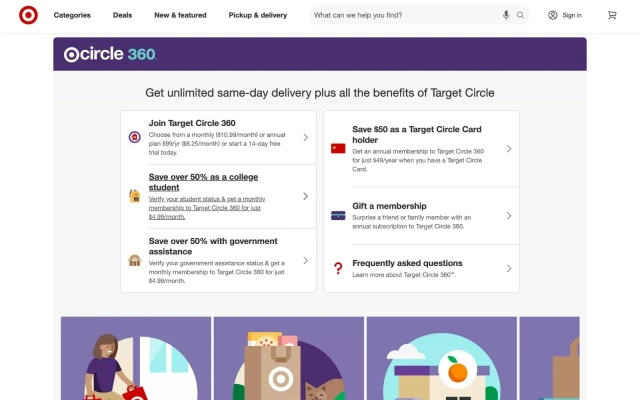
Members earn 1% of their purchases back, which they can redeem for future purchases. They also gain access to exclusive deals and personalized savings tailored to their shopping habits.
Unique features:
- A pricing plan to join the Target Circle 360 to unlock benefits
- Community engagement through voting on Target’s local charity donations.
- Ability to stack rewards with Target RedCard benefits
Retail merchants' takeaways:
- Community voting turns loyalty into identity
- Stacking rewards increases perceived value on occasion, but needs guardrails
3. Gap Good Rewards
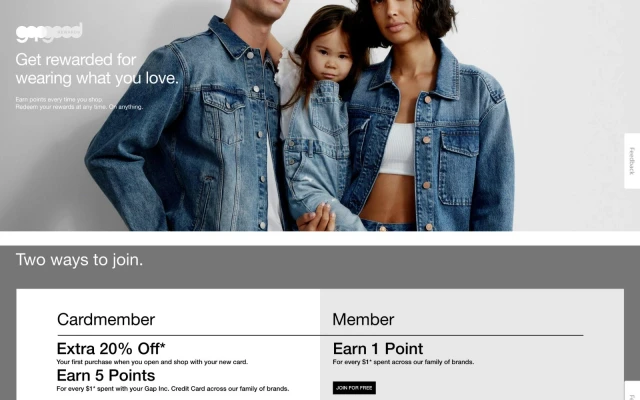
Gap Inc., a global fashion retailer, integrates its loyalty program across multiple brands, including Gap, Old Navy, and Banana Republic. Gap Good Rewards has been instrumental in boosting cross-brand engagement, with millions of active members benefiting from the seamless earning and redemption system.
Members earn 1 point per $1 spent across all Gap Inc. stores. Every 100 points equate to $1 in rewards, redeemable across participating brands, offering flexibility and convenience.
Unique features:
- Points are earned and used across multiple brands.
- Higher-tier members receive exclusive benefits like free shipping.
- Members gain early access to sales and limited collections.
Fashion merchants' takeaway:
- Design multi-brand points, whether in the same industry or not. For example: Clothing brand + jewelry + sustainable shoes = a complete outfit ecosystem
- Set clear tier-gated free shipping, especially in the fashion industry, shipping cost eats into the high margin when there are 20-40% returns
4. The LIVELY Rewards
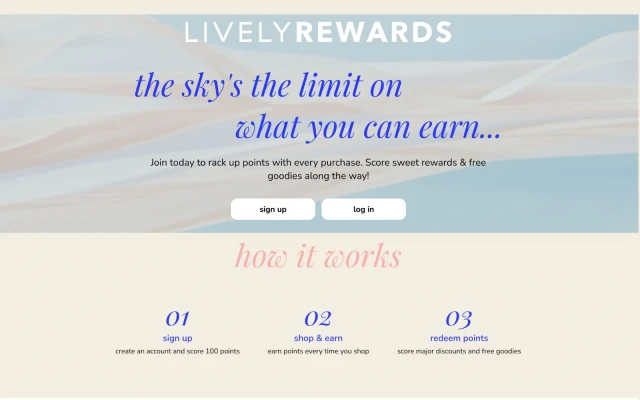
LIVELY, a lifestyle brand specializing in bras and loungewear, launched The LIVELY Rewards program to foster strong brand loyalty and community engagement. By rewarding purchases and brand interactions, the program has effectively increased repeat customer rates and social media presence.
Members earn 10 points per $1 spent and can also gain points for activities like following LIVELY on Instagram or referring friends. Points can be redeemed for discounts, with 100 points equaling $10 off.
Unique features:
- Non-purchase activities, like writing reviews or referrals, are incentivized.
- Access to exclusive content and early product launches for members.
- A focus on building community through shared brand values.
Fashion merchants' takeaway:
- Expand earnings beyond purchases to keep the brand top of mind between drops
- Build a community around shared values to create retention
5. Adidas adiClub
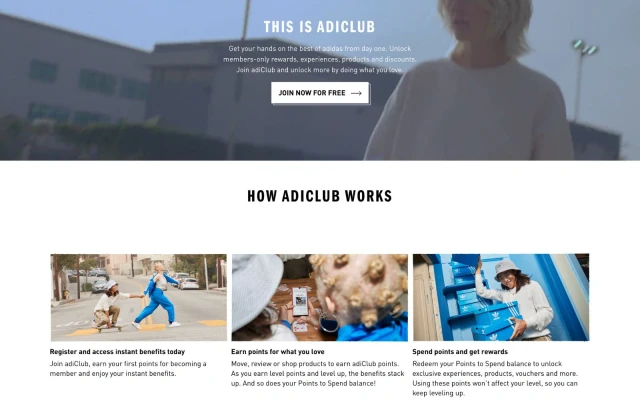
Adidas, a global leader in sportswear, leverages its AdiClub loyalty program to strengthen its connection with fitness enthusiasts. With millions of active members, adiClub offers points for purchases and brand engagement, driving both sales and customer satisfaction.
Members earn 10 points for every €1 spent, along with additional points for app activities like completing workouts. Points unlock tier-based benefits, with higher tiers offering greater rewards and experiences.
Unique features:
- Tiered system (Bronze to Platinum) incentivizes engagement.
- Exclusive access to limited-edition products and events.
- Integration with the Adidas app for personalized fitness content and challenges.
Fashion merchants' takeaway:
- Run a tier ladder that makes progress feel earned and visible
- Connect loyalty to the brand app to create a habit loop between purchases

You've seen 5 inspiring examples – now unlock more from top brands like Sephora, Marriott Bonvoy, IKEA, and others. Exclusive breakdowns inside!
Which model should your business use?
Loyalty programs take several forms, such as loyalty point programs, VIP tiers, percent back rewards, paid membership, or a hybrid of these models. As a result, many merchants spend weeks testing different setups before they choose one. To cut that time, the comparison below gives a clear overview of the main options and when each one fits.
In this comparison, I group merchants into four business sizes: micro, small, medium, and large. I then rate each option using the legend below.
BF = Best fit as the core model
C = Consider it or add it later
NP = Not a priority at this stage
| Business size | Point based | VIP tiers | Percent back | Paid membership | Hybrid |
|---|---|---|---|---|---|
| Micro | 🟢 BF Fastest launch | ⚪ NP Too heavy ops | 🟢 BF If margins allow | ⚪ NP Hard to justify | ⚪ NP Too complex |
| Small | 🟢 BF Easy base program | 🟡 C Simple VIP level | 🟢 BF Promos, key cats | 🟡 C For superfans | 🟡 C Light hybrid works |
| Mid size | 🟢 BF Table stakes | 🟢 BF Protect top 10 to 20% | 🟡 C Tactical lever | 🟡 C Heavy user club | 🟢 BF Full hybrid ready |
| Large | 🟢 BF Consistent system | 🟢 BF Full status ladder | 🟡 C Banks, wallets | 🟢 BF Subscription tiers | 🟢 BF Advanced hybrid |
How to Create a Point-Based Loyalty Program for Your Shopify Store
As a Shopify merchant, having an impressive loyalty program will make your store stand out. Here’s a step-by-step guide to creating an effective point-based loyalty program on Shopify
Step 1: Understand Your Customer and Define Your Objectives
First and foremost, analyze your customer base and define your goals.
- Customer insights:
- Who are they? Identify your target audience. Are they budget-conscious shoppers, repeat buyers, or one-time customers?
- What motivates them? Look into what drives their loyalty—discounts, exclusive perks, or personalized experiences.
- How do they shop? Analyze purchasing behavior, average order value, and preferred channels (online, mobile, social media).
- Set objectives:
- What do you want to achieve? Do you want to increase repeat purchases, boost customer engagement, or encourage referrals or social shares?
- What metrics will you measure? Retention rate, lifetime customer value, or referral conversions.
Step 2: Choose The Right Shopify Loyalty App
Shopify does not have a built-in point-based loyalty feature, so you’ll need to select a third-party app to manage your program from the Shopify App Store. The most popular and high-rated options are:
- Smile.io stands out for its robust tiered loyalty programs and gamification features, such as badges and VIP tiers, which create an engaging customer experience.
- LoyaltyLion focuses on personalization and advanced analytics, making it an excellent choice for scaling stores seeking in-depth insights into customer behavior.
- Yotpo Loyalty & Rewards integrates loyalty programs with product reviews and offers omnichannel reward options, ensuring a seamless customer experience.
- Growave is a tool that combines reviews, wishlists, and loyalty rewards. It is a practical solution for small businesses that want to consolidate features.
Joy Rewards and Loyalty Program offers an intuitive setup and allows merchants to reward customers for purchases, referrals, and social media interactions. You can customize your landing pages, widgets, and pop-ups to fit your branding and maximize promotion.
Joy is highly recommended for its simplicity, powerful customization options, and ability to quickly set up an engaging loyalty program in Shopify. It is perfect for businesses of all sizes.
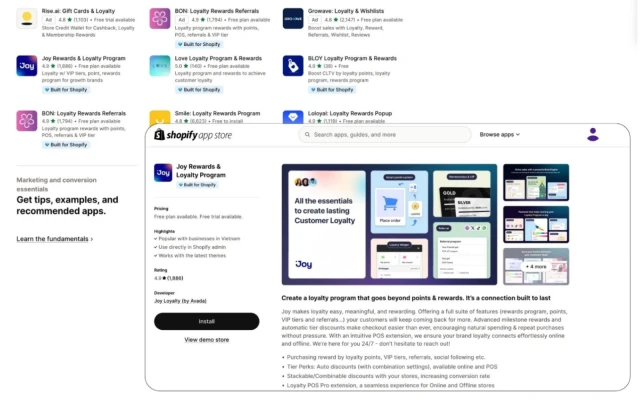
Choose the most suitable app and install it in your Shopify store by clicking the Install button.
Step 3: Determine Earning and Redemption Rules
The heart of the program lies in the rules. Set up clear guidelines for how customers will earn and redeem points, which will significantly affect the sales operations.
From here, I’ll guide you with the setup of the Joy Rewards and Loyalty Program app, using its advanced plan for more features.
Access the Reward program:
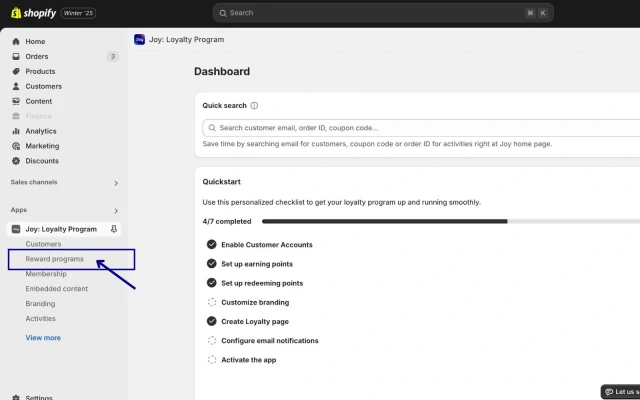
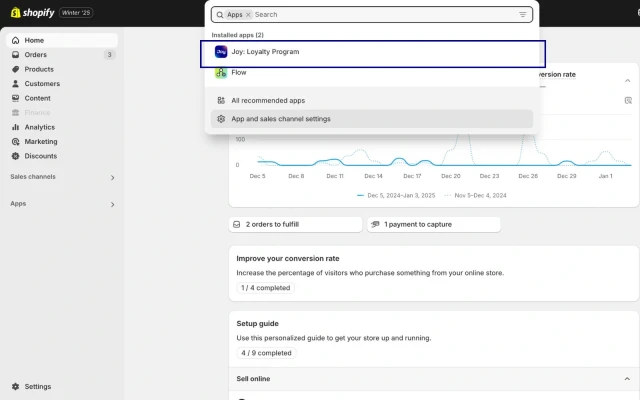
From your Shopify admin, click Apps and select Joy Loyalty you just installed to go to the app’s dashboard.
- Click Earning Program. This is where you decide which actions to reward and how many points to award for each action.
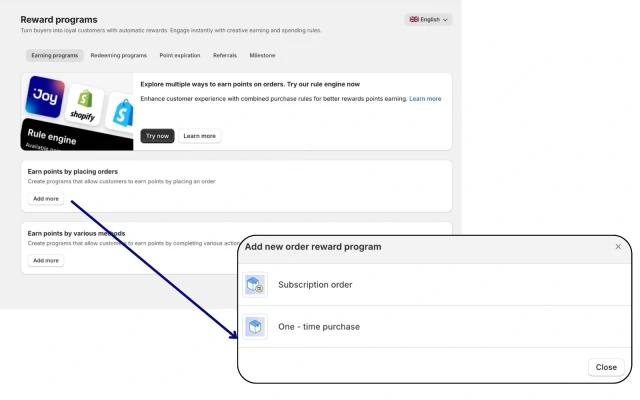
- In the Earn points by placing orders, click Add more.
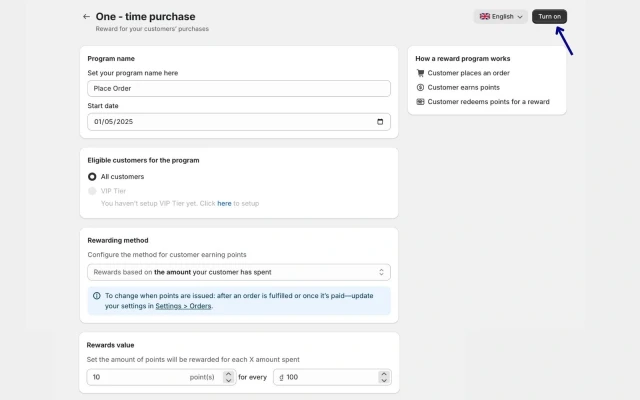
- If you want to reward customer based on their purchases, choose One-time purchase order.
Choose one of the two rewarding methods: each time purchase or amount spent. Set how many points to reward customers in the reward value section.
If you offer subscription boxes or services, choose Subscription order
- Scroll down and check the box next to the sale channels (online store, POS, or both) you want to apply to.
- Once done, click Turn on to enable it.
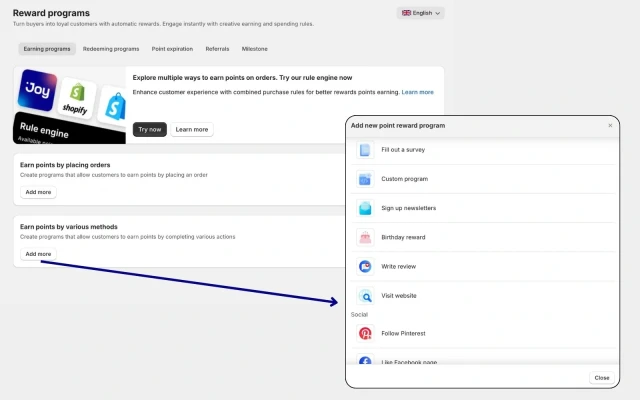
- Beyond purchases, you can reward customers for engaging with your brand via various actions. Scroll down to the Earn points by various methods section, and click Add more.
- Choose actions:
- Signing up for the program
- Writing a product review
- Referring a friend
- Following the social media account
- Sign up for the newsletter
- Set up the earning points for each action and click Turn on.
Birthday reward
- Now, click Redeeming Program. Here, you will determine which rewards you’ll give customers and how many points customers can exchange for each reward.
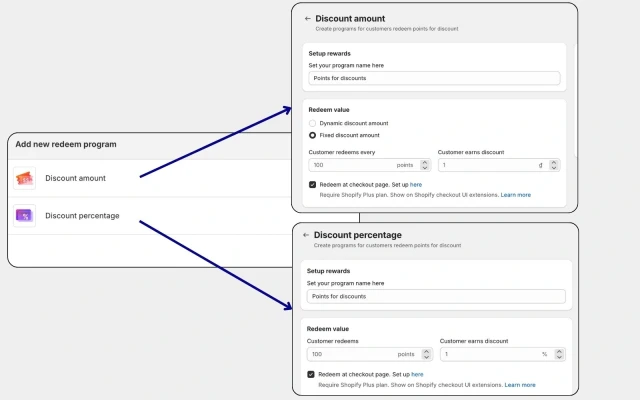
Choose an appropriate benefit and click Add more.
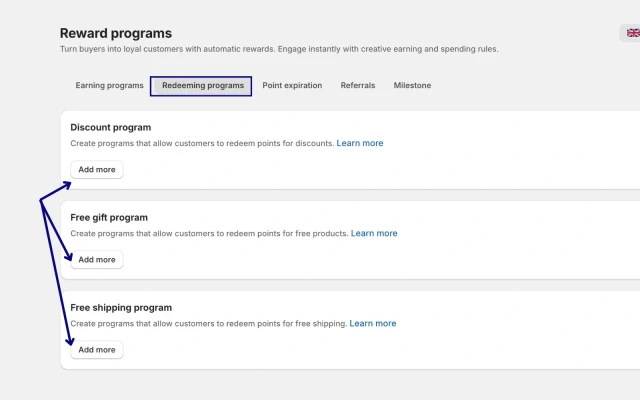
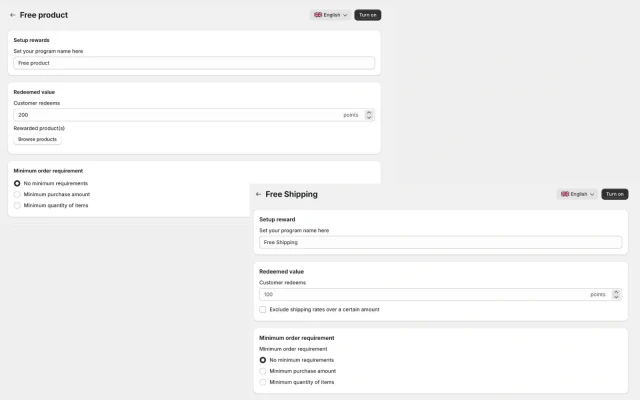
Free gift: Choose the product and the number of points customers need to exchange this reward.
Discount: You can choose to discount a certain amount or discount by percentage (e.g., 1 point = $1 or 1 point = 1% off).
- Free shipping: Set the exchange rate points the customer needs to get free shipping or a discount on shipping fees.
- Click Turn on to activate the redeeming rules.
Step 4: Design the Program’s Interface
Impression comes at first sight, and Joy Loyalty apps can also help Shopify merchants make their loyalty programs visually appealing and easy to navigate.
Add a Loyalty Widget
You can customize the widget’s appearance, including its colors, text, and placement, to match your store’s branding.
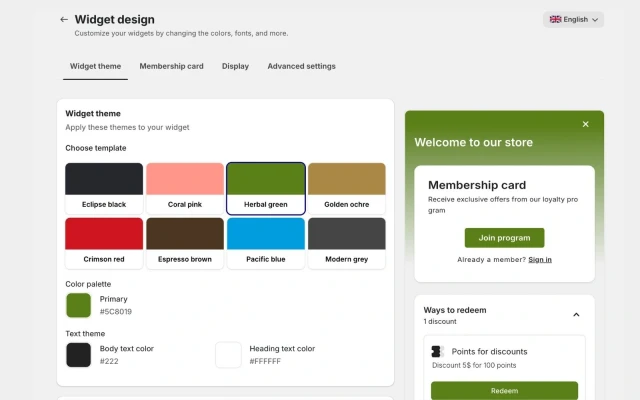
Navigate to the Branding and access the Widget design section.
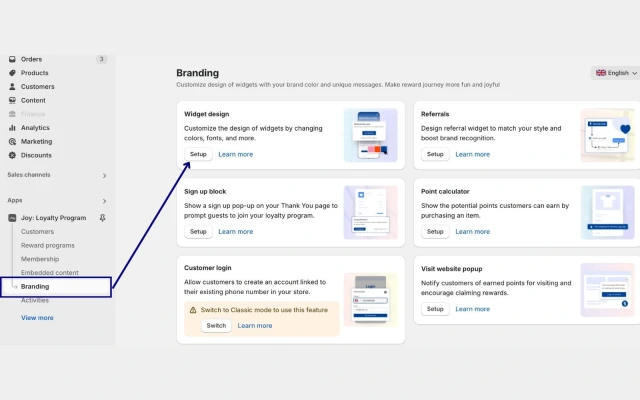
- Enable the widget to display on your website.
Create a Landing Page
- Go to the Embedded Content section and click Edit in the theme editor in any block.
This will take you to the loyalty page on your Shopify theme. Here, you can add more blocks to showcase the program details by clicking Add section > Apps > Select the blocks, such as how it works, ways to earn, redemption options, FAQs, and VIP tiers.
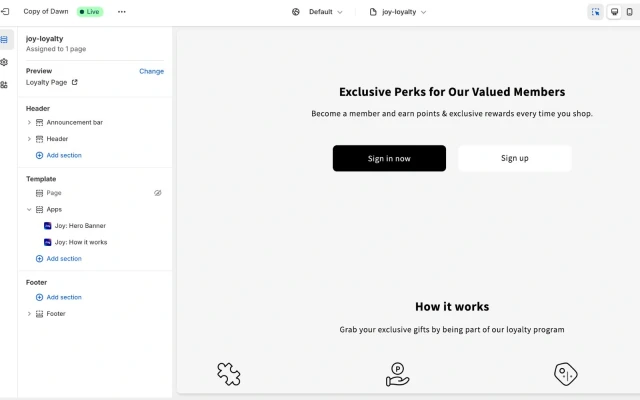
- Customize it with your branding, images, and click Save to publish the page.
Step 5: Promote Your Program
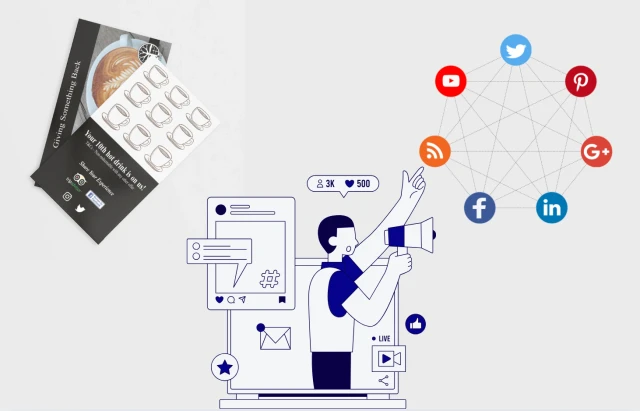
Even the best-designed loyalty program won’t succeed without effective promotion.
- Announce it: Use email campaigns, website banners, and social media posts to inform customers about the program.
- Incentivize sign-ups: Offer bonus points for joining the program to encourage immediate participation.
- Highlight benefits: Regularly showcase rewards, customer success stories, or limited-time bonus point events to keep your audience engaged.
Step 6: Track and Optimize
Once your program is live, monitor its performance and adjust it as needed. Use Joy’s powerful analytics tools to achieve optimal results.
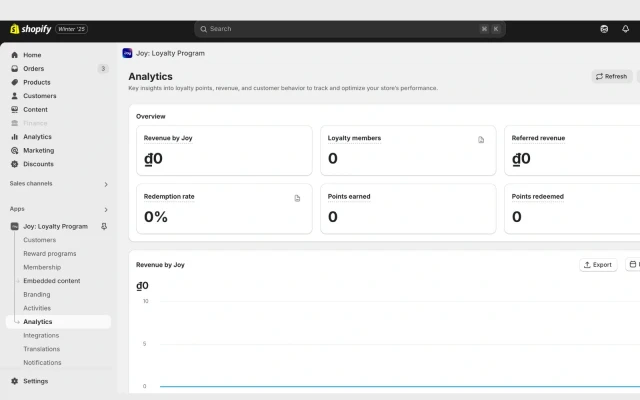
- Track metrics: Analyze data like enrollment rates, point redemptions, and repeat purchase frequency.
- Gather feedback: Ask customers for feedback to identify areas for improvement.
- Optimize rewards: Introduce new rewards or bonus point opportunities to keep the program fresh and exciting.
4 Common Mistakes to Avoid in Creating Point-Based Loyalty Programs
A point-based loyalty program can drive customer retention and sales—if done correctly. Many programs fail due to avoidable mistakes. Here are the most common pitfalls and how to steer clear of them:
- Overly complex earning and redemption rules: If customers find it difficult to understand how to earn or redeem points, they are less likely to engage with the program.
👉 Keep the rules simple and straightforward. Provide clear instructions and accessible FAQs to help customers navigate the system.
- Low perceived value of loyalty point rewards: Customers may lose interest if they feel the rewards are not worth the effort or if redemption feels unattainable.
👉 Ensure your rewards align with customer preferences and offer a mix of achievable short-term rewards and valuable long-term incentives. Review and update your reward catalog regularly based on customer feedback and trends.
- Setting points that expire too soon: Customers may feel frustrated or lose trust in the program if they can’t redeem their points in time.
👉 Clearly communicate point expiration policies and send reminders about upcoming expirations.
- Overlooking personalization: Offering generic rewards or failing to tailor experiences to individual customers makes them feel unvalued and less motivated.
👉 Leverage customer data to offer personalized rewards such as product recommendations, exclusive deals, or birthday bonuses.
Start Setting Up A Loyalty Program In Minutes With Joy
Now you know all the basics of point-based loyalty programs. Remember, a successful program is about more than just handing out points. It’s about creating a rewarding experience that keeps your customers engaged.
Following the steps outlined in this guide, you can design a program that delights your customers, drives business growth, and strengthens your brand. And if you’re looking for a user-friendly and affordable platform to help you build and manage your program, Joy Loyalty is a fantastic choice!
FAQs
1. Do I need a Shopify loyalty app to run a points program?
You can run a basic rewards offer without an app, but you will hit manual work fast. Joy Loyalty helps you run the full loop in one place, including earning rules, points balance, and rewards customers can redeem without you doing it by hand. As a result, the program feels real to customers because it works every time they check their points.
2. What is the fastest way to set up a loyalty point program on Shopify?
Start with one clear earn rule and one easy first reward. First, set points per dollar. Next, set a first reward that most customers can reach within one to two orders. Then, show points progress where it changes decisions, cart, account page, and post-purchase email. From there, add one bonus action, like review,s if you want extra engagement between orders.
3. Should points expire?
The answer is yes, but only when implemented through a carefully calibrated framework that balances liability management with transparent communication and customer-centric safeguards.
Programs without expiration face mounting balance sheet liabilities, reduced customer engagement, and "points fatigue," while poorly executed expiration policies trigger customer defection and brand damage.




-a7e9a3.png?width=828&q=75&f=webp&auto=format)