The average U.S. consumer belongs to 19 loyalty programs but actively uses fewer than half of them. That gap between enrollment and engagement isn't a design problem. It's a management problem.
If you've launched a loyalty program and it's just sitting there, you're not alone. Most programs start strong and then quietly flatline. Not because the structure was wrong, but because nobody's actively running the thing.
This guide covers what loyalty program management actually looks like day to day: the KPIs worth tracking, the team responsibilities, the best practices that separate growing programs from stagnant ones, and the technology decisions that matter at different scales. No single formula works for every brand. What works depends on your size, your margins, and your goals. But the work itself? That's what we're here to break down.
Key Takeaways
- 19 loyalty programs per consumer, and fewer than half are ever used. The gap between enrollment and engagement isn't a design problem. It's a management problem.
- Launch is step one. Management is everything after. Most programs flatline not from poor structure, but because nobody actively runs them post-launch.
- Redemption rate beats total sign-ups as your lead KPI. What gets measured gets managed. Track the numbers that predict repeat revenue, not the ones that look good in a report.
- Segmentation, gamification, and personalization are active disciplines. One reward email to your whole list is a blast, not a loyalty strategy.
- If nobody sees the numbers, nobody funds the program. Build the report. Tie it to CLV, Assisted Orders revenue, and repeat purchase rate. That's when the loyalty program stops being a cost center and starts being a growth lever.
What Is Loyalty Program Management?
Loyalty program management is the ongoing work of designing, running, measuring, and improving a rewards program across the full customer lifecycle.
That includes setting earning rules, building reward structures, segmenting members, launching campaigns, tracking performance, and refining the program as customer behavior, margins, and retention goals change.
A loyalty program is not something you launch and leave alone. To stay effective, it needs regular review, optimization, and active management.
Why Loyalty Program Management Matters More Than Ever
Customer acquisition is more expensive than ever, with costs having risen 222% over the past decade. That makes retention more important than ever.
Loyalty program management matters because it helps turn retention into a repeatable growth lever. The category itself reflects that shift: the loyalty management market was estimated at $14.28 billion in 2025 and is projected to reach $31.77 billion by 2030, growing at a 17.34% CAGR (Compound Annual Growth Rate).
But those results do not come from launching a program alone. They come from managing it well. Without active oversight, loyalty programs become costly to maintain, harder to justify, and less effective at driving repeat purchases.
9 Best Practices for Managing a Loyalty Program That Actually Grows
Every loyalty program that lasts runs on four pillars: relevance (rewards members actually want), value (rewards worth the effort to earn), experience (the program feels frictionless to use), and communication (members always know what they have and what they can unlock).
The nine practices below are how those pillars hold up after the launch, when autopilot would otherwise take over.
1. Set Clear KPIs Before You Touch Anything Else
Sign-ups may look good in a report. However, they do not tell you whether your program is driving revenue.
A loyalty program with 10,000 members and a 14% redemption rate may look healthy on the surface, but it is likely underperforming. A program with 3,000 members and a 35% redemption rate is often far more valuable because members are actively engaging with it.
That is the difference between a program that exists and a program that performs.
To manage loyalty well, track the metrics that show participation, reward value, and business impact.
KPIs that drive loyalty program management:
| KPI | What does it tell you | Healthy benchmark |
|---|---|---|
| Active member rate | Are members actually participating? | Above 40% |
| Redemption rate | Are rewards compelling enough to use? | Above 20% |
| Repeat purchase rate | Is the program driving second- and third-order effects? | Track trend, not just a snapshot |
| CLV: members vs. non-members | Is the program producing higher-value customers? | Members spending 15%+ more |
| Churn rate | How fast are you losing members? | Lower than your acquisition rate |
What to stop celebrating: total sign-ups, app downloads, and email list size. These are inputs. Not outcomes.
Most loyalty apps show redemption rate and loyalty members on the main dashboard. If yours doesn't surface these numbers without digging, that's a red flag.
Joy Loyalty's Assisted Orders report consolidates all five KPIs above into a single dashboard: redemption rate, repeat purchase rate, CLV for members vs. non-members, and direct revenue attribution per campaign. Most loyalty apps stop at enrollment and points balance. Joy shows you what the program is actually earning. That's the number your finance team cares about.
What this looks like in practice: A home fragrance brand celebrated hitting 10,000 loyalty members. The CEO put it in an investor update. Then the retention marketer pulled the real numbers:
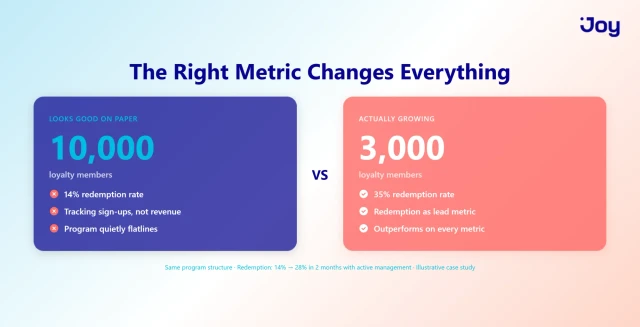
The program wasn't retaining anyone. It was collecting names. They shifted focus to redemption rate as the lead metric, lowered the reward threshold from 500 to 200 points, and saw redemption jump to 28 percent in two months. Same program. Different management focus.
2. Segment Your Members (Don't Treat Everyone the Same)
Sending the same reward email to your entire list is not a loyalty strategy. It is a broadcast. And broadcast-level loyalty produces average results.
When every member gets the same “double points weekend” offer, you waste margin on low-value shoppers and miss the chance to deepen retention with your best customers. Segmentation fixes that.
You do not need 20 micro-segments. You need a few that drive action.
Start here:
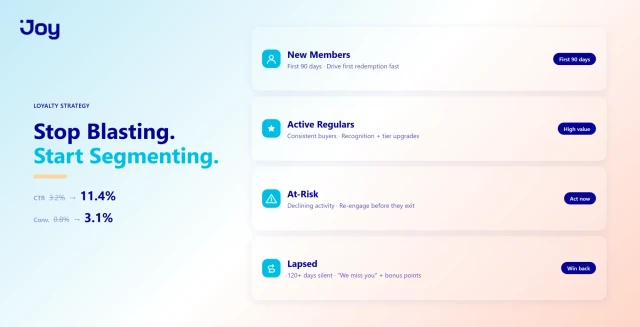
The first 90 days matter most. 65% of a customer’s 365-day CLV is realized on the first purchase. By 90 days, that number reaches 79%. If you're not running specific campaigns for new members during that window, you're losing the customers most likely to become your best ones.
Most loyalty apps with VIP tiers can automatically segment members by spend. Use those tiers to create segment-specific rewards: free shipping for mid-tier, early access for top-tier. Then connect those segments to your email platform, whether that is Klaviyo, Shopify Email, or another tool, and trigger flows that match each group’s behavior.
For example:
- new member welcome flows
- tier-upgrade milestone emails
- VIP-only reward drops
- Win-back campaigns for members are losing momentum
The goal is simple: send the right reward to the right member at the right time. That is how segmentation turns loyalty from a generic program into a retention system.
What this looks like in practice: A skincare brand doing $80K/month on Shopify had 4,200 loyalty members. They sent the same "double points weekend" email to all of them.
- Click rate: 3.2% ·
- Conversion: 0.8%
Then they split the list into three segments and tailored each message. New members got a "redeem your first reward" push. Regulars got early access to a new product. Lapsed members got a "we miss you" offer with 100 bonus points.
- Combined click rate: 11.4% ·
- Conversion: 3.1%
Same promotion budget. Four times the results. The only difference: they stopped treating 4,200 people as one audience.
3. Add Gamification Mechanics to Drive Habit Loops
Points earn revenue. Gamification earns habits.
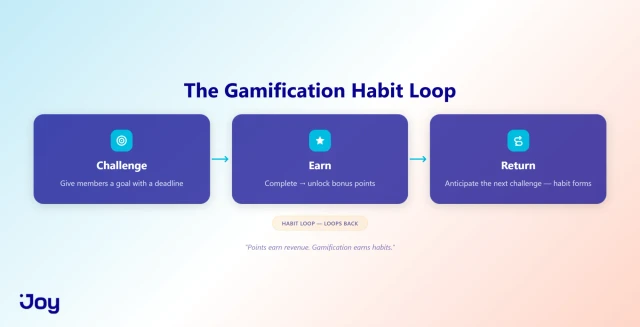
A standard points program gives members a reason to spend. A gamified program gives them a reason to come back. The mechanics are different: challenges, streaks, and milestone unlocks create momentum for progress.
Discounts can't replicate it. Competitors can't copy it. The pull is behavioral, built into the customer's habit pattern, not just the economics.
Gamification mechanics worth building into your program
| Mechanic | How it works | Why members respond |
|---|---|---|
| Challenges | "Complete X actions by Y date → earn bonus points" | Creates urgency and a specific reason to act now |
| Streaks | Bonus points for consecutive purchase months | Reinforces frequency without cutting your margins |
| Milestone unlocks | Reward triggered at specific point thresholds, not just tier levels | Progress is visible — members always see exactly what's next |
| Point multiplier events | 2x or 3x earn on specific products or dates | Makes the program feel alive; drives category sales without blanket discounts |
| Tier-up celebration | Recognition moment every time a member advances | Emotional payoff that makes tier progression feel real, not administrative |
The management rule: run one active mechanic at a time. A single well-run challenge outperforms five overlapping ones. Members engage with clarity. They disengage with complexity.
What this looks like in practice: A home fragrance brand added one monthly challenge: "Buy any two products from the new seasonal collection, earn 500 bonus points." No discount. No free shipping. Just a goal with a deadline.
Challenge participation rate in month one: 34% of active members
They ran the same structure for three months, rotating the collection each time. By month three, members were checking the app before the challenge launched to see what was next.
That's what gamification builds. Not just response: anticipation.
4. Make Onboarding Frictionless (and Educational)
The first interaction after sign-up often determines whether a member becomes active or disappears.
Most programs lose momentum here. A customer joins, gets a generic confirmation email, and never engages with the program again.
Two things fix that: reduce friction at enrollment and educate members immediately after.
Friction means making sign-up as easy as possible. On Shopify, that usually means adding loyalty enrollment to the checkout page, the account page, and the post-purchase flow. If customers have to visit a separate page or create another login, drop-off starts early.
Education means showing members how the program works right away. A simple welcome flow should answer three questions:
| Timing | Message | |
|---|---|---|
| 1 | Day 0 | "You just earned X points. Here's your first reward." |
| 2 | Day 3 | "You're X points from the next tier. Here's what you unlock." |
| 3 | Day 10 | Refer a friend. You both earn bonus points. |
The goal is to get the first redemption fast. Members who redeem early stay active. Members who don't drift. That's the whole equation.
5. Monitor and Prevent Churn Proactively
By the time a customer leaves, you've already lost. The goal isn't to react to churn. It's to spot it before it happens.
Churn doesn't start with a cancellation. It starts with silence. A VIP member who ordered monthly now hasn't ordered in 45 days. A Gold-tier customer who used to redeem rewards every quarter skips two in a row. These are signals. And most programs ignore them.
Early warning signs to track:
Businesses using churn prediction models can reduce attrition by up to 30%. You don't need machine learning to start. On Shopify, set up a Flow automation: if a tagged loyalty member hasn't ordered in 60 days, trigger an email with a bonus points offer or a personal check-in from your team.
The key: act during the silence, not after the exit.
What this looks like in practice: A pet supplies brand on Shopify noticed its churn rate climbing from 18% to 26% over two quarters. They didn't know why until they pulled the data. Members who reached the Gold tier churned fastest. The reason: Gold required 1,000 points, but the first reward started at 1,500. Members hit Gold, saw no immediate reward, and stopped engaging.
- Gold-tier churn rate: 34% ·
- Average time from Gold to last purchase: 42 days
They added a reward at 1,000 points (free shipping for three months) and built a triggered email for the day a member hit Gold: "You just unlocked free shipping. Here's how to use it."
- Gold-tier churn rate 90 days later: 16%
Same tier. Same members. The only change: someone noticed the gap and closed it.
6. Personalize Rewards (Beyond "Dear {First_Name}")
Personalization in loyalty isn't adding a first name to an email. It's matching the reward to the behavior.
A customer who buys coffee beans every three weeks doesn't want 10% off a mug. They want early access to the new roast or bonus points on their next bag. The more the reward reflects what the member actually does, the more it reinforces the behavior you want repeated.
McKinsey found that companies excelling at personalization generate up to 40% more revenue than their slower-growing competitors. And 91% of consumers say they're more likely to shop with brands that provide relevant offers.
You don't need an AI engine to start. You need to purchase data and a few rules.
Simple personalization framework for Shopify merchants:
Connect your loyalty app to Klaviyo or Shopify Email. Use purchase history tags to trigger segment-specific flows. A "coffee buyer" tag triggers a different reward email than a "gear buyer" tag. That's personalization that works at Shopify scale without a data science team.
What this looks like in practice: A DTC fitness brand offered the same $10 coupon to all loyalty members who hit 500 points. Redemption rate: 12%. They split the reward by purchase behavior. Apparel buyers got early access to new drops. Supplement buyers got a free sample with their next order. Equipment buyers got a bundle discount.
Redemption rate after personalization: 27%
Same point threshold. Same cost to the business. The reward just matched what the member actually wanted.
7. Test and Iterate Your Reward Structure
The reward structure you launched with is almost certainly not the one you should be running six months later. Customer behavior shifts. Margins change. Competitors adjust their offers. A static rewards program is a decaying one.
This is where active management earns its keep.
What to test:
Run one test at a time. Give it 30-60 days. Measure against a specific KPI from Practice 1, not against a vague sense of "how it's going."
McKinsey found that offering a points-plus-cash option can increase redemptions by 20 to 25%. That's one structural change. One test. Measurable outcome. That's what iteration looks like.
On Shopify, most loyalty apps let you adjust point ratios and reward thresholds without rebuilding the program. Use that flexibility. If you haven't changed your reward structure since launch, it's overdue.
What this looks like in practice: A jewelry brand set their first reward at 500 points (equal to $500 in spend). Redemption rate after six months: 8%. Most members never got close. They tested a lower threshold: 150 points for a $5 reward. Not a big payout. But members could reach it after one or two orders.
- Redemption rate after threshold change: 22%
- Repeat purchase rate among redeemers: 3.2x higher than non-redeemers
The original structure looked generous on paper. In practice, it was unreachable. Testing revealed what the dashboard couldn't.
8. Connect Loyalty to Your Full Tech Stack
A loyalty program that lives in isolation underperforms. The real power shows up when your loyalty data flows into your email platform, your analytics, your customer support tools, and your checkout experience.
On Shopify, this means connecting your loyalty app to the tools you already use:
The principle is simple: every touchpoint where a customer interacts with your brand should know they're a loyalty member and act accordingly.
When a VIP emails support, the agent should see their tier and lifetime value. When a Gold member reaches checkout, the points balance should appear without the member having to look for it. When a subscriber cancels, the retention offer should reflect their loyalty status.
Behavioral segmentation tied to loyalty data can yield 10 to 20% increases in customer acquisition, 10-15% lifts in long-term value, and 20-30% boosts in satisfaction.
What this looks like in practice: A home goods brand on Shopify had a loyalty program, a Klaviyo account, and a review app. None of them talked to each other. Loyalty members got the same emails as non-members. Review requests didn't mention points. Klaviyo segments didn't include tier data.
They connected all three. Loyalty tier tags flowed into Klaviyo. Review requests offered 50 bonus points. Post-purchase emails showed points balance.
- Email revenue from loyalty members: up 38% in 60 days
- Review submission rate among members: up 52%
No new tools. No new budget. Just connections between the ones they already had.
9. Report Results to Stakeholders (Even If You're the Stakeholder)
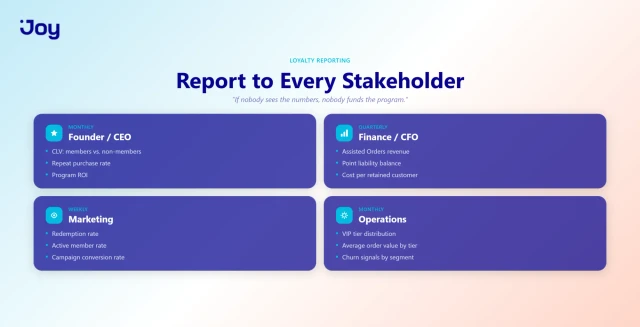
If nobody sees the numbers, nobody funds the program. This is true whether you're reporting to a board, a marketing director, or yourself.
Most loyalty programs die not from failure but from invisibility. The program works. Retention improves. But nobody connects those improvements to the loyalty program because nobody built the report.
The Core Responsibilities of a Loyalty Program Manager
The job title varies, such as Loyalty Manager, CRM Lead, Head of Retention, or just "the person who handles the rewards program." The title doesn't matter. The work does. And it breaks down into five functional areas:
- Program design and iteration.
- Data analysis and segmentation
- Campaign management
- Cross-functional coordination
- Financial oversight
Most Shopify merchants don't have a dedicated loyalty role. The founder or marketing lead handles it alongside everything else. That's fine. But the work still needs to happen.
If you're spending two hours a week on loyalty program management, here's a rough split: 30 minutes on data review, 30 minutes on campaign setup or adjustment, 30 minutes on program design tweaks, and 30 minutes on reporting and cross-team communication. Not glamorous. But it's the work that keeps a program alive.
How Technology and AI Are Changing Loyalty Management
Technology doesn't replace loyalty program management. It enables management at scale.
Management Is the Program
The gap between a loyalty program that grows revenue and one that collects dust isn't the reward structure. It isn't the tier names. It isn't the app.
It's whether someone shows up every week to look at the numbers, adjust what isn't working, and act on what is.
Every section of this guide comes back to the same idea: the program doesn't run itself. Active management is the differentiator. Set KPIs. Segment members. Onboard with purpose. Catch churn early. Personalize rewards. Test the structure. Connect the stack. Report the results.
The merchants who do this work, even two hours a week, build programs that compound. The ones who don't build programs that decay.
The program you launched is the starting point. The program you manage is the one that grows.