Most e-commerce stores treat loyalty programs as a marketing add-on. A points widget here, a referral bonus there. Something you bolt onto the checkout page and hope for the best.
But a loyalty program business model is something different. It's a growth strategy that puts returning customers at the center of how your store makes money. Instead of spending most of your budget chasing new buyers, you build around the ones who already trust you enough to purchase once.
The math backs this up: Companies that prioritize retention over acquisition are 60% more profitable.
This guide covers what a loyalty business model actually looks like, three strategic approaches for different types of stores, a practical framework for building one, and the metrics that indicate whether it's working.
Key Takeaways
- A loyalty program business model puts returning customers at the center of how your store makes money, not just as a marketing add-on.
- Companies that prioritize retention over acquisition are 60% more profitable. The math backs a retention-first approach.
- Three strategic approaches covered for different store types, plus a practical framework for building your own model.
- The difference between "having a loyalty program" and "running a loyalty business model" is whether retention drives your revenue strategy.
- Track program-attributed revenue, repeat purchase rate, and CLV to know if your loyalty model is actually working.
I. What Is a Loyalty Program Business Model? (And Why It's Not Just "Having a Loyalty Program")
A loyalty program business model is a growth strategy in which your revenue, marketing, and customer experience are structured around one idea: keeping the customers you already have.
It's not a campaign. It's not a feature you toggle on in your Shopify admin. It's a business-level decision about where growth comes from.
In this model, your store grows because customers buy again, spend more over time, and bring in new buyers through referrals and word of mouth. Every decision supports that loop, from how you split your marketing budget to how you handle post-purchase emails to how your support team treats a complaint.
Here's a number that makes the case clearly: loyal customers account for just 8% of an e-commerce site's traffic but generate 41% of its total revenue. A small group of returning buyers accounts for nearly half of the incoming revenue. The loyalty business model is built around growing that group.
The business model is not the program
This is where most stores get confused. A points-based rewards system is a mechanism. A tiered membership structure is a mechanism. A referral bonus is a mechanism. These are tools you can use inside a loyalty business model, but they aren't the model itself.
The model is the strategic decision to orient your business around retention. The program is one piece of that.
Think of it like this. Two Shopify stores both run a points program. Same app, same basic setup.
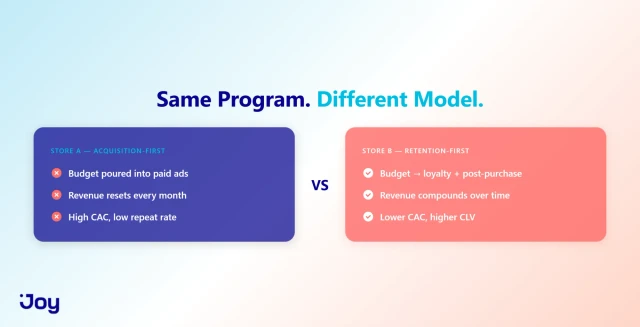
Same program. Different business model. After 12 months, Store B has a higher repeat purchase rate, a lower cost per sale, and customers who stick around longer.
The difference isn't the rewards widget. It's the decision about what drives growth.
II. Why This Model Works: The Financial Case for Retention-First Growth
The loyalty business model isn't just a philosophical shift. It's a financial one. And the numbers are hard to ignore.
1. Acquisition costs more than you think
Getting a new customer costs roughly five times more than getting an existing one to buy again. That ratio gets real when you put dollars on it.
If your Shopify store spends $35 to acquire a new buyer through paid ads, a second purchase from someone already in your customer list might cost $5 to $7 through a well-timed email and a loyalty reward. Same revenue, fraction of the cost.
2. Retention compounds
A 5% improvement in customer retention can increase profitability by 25% to 95%. That range is wide, but the principle is consistent: when customers come back, they buy more frequently, spend more per order, and try products they wouldn't have risked on a first visit. The value doesn't just add up. It compounds.
Acquisition-based businesses don't get this benefit. Their revenue resets every month. When ad costs spike or a platform algorithm shifts, sales drop with it. Loyalty-based businesses have more predictable revenue because a larger share comes from customers who have already decided to return.
3. Loyal customers do your marketing for you
Here's the part that doesn't show up in most ad dashboards: 86% of loyal customers recommend brands to friends and family. That's word-of-mouth acquisition you didn't pay for. Every retained customer who refers someone is reducing your future CAC without you spending a dollar.
Retention doesn't just save money. It creates a growth loop.
The caveat
These numbers don't mean every retention-focused store automatically wins. A loyalty business model with confusing rewards, slow support, or rewards nobody wants will underperform an acquisition model with sharp ads and a strong funnel.
The model is the foundation. Execution is what makes it work. And that starts with choosing the right strategic approach for your type of store.
III. Three Strategic Approaches to a Loyalty Business Model
There's no single loyalty business model that works for every store. The right approach depends on what you sell, how often customers buy, and what makes them come back.
Below are three strategic approaches. Each one represents a different growth logic. And each one uses different loyalty program mechanics (points, tiers, referrals) as tools to support that logic.
The key distinction: these aren't program types. They're business strategies. Two stores might both run a points program, but the strategic intent behind each can be completely different.
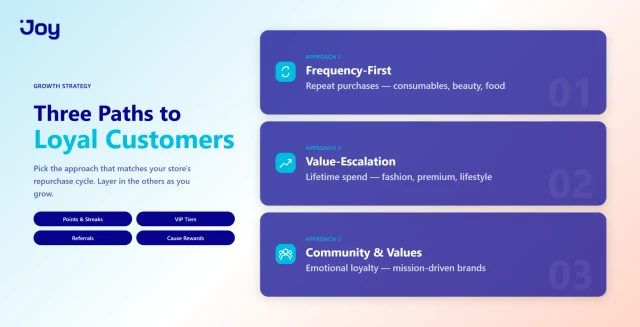
Approach 1: Frequency-first (optimize for repeat purchases)
What it is. Your growth comes from getting customers to buy more often. The business is built around products that run out and need to be replaced.
How it works. The entire customer experience is designed to shorten the gap between purchases. Post-purchase emails remind customers when it's time to reorder. Loyalty rewards are calibrated to encourage the next purchase, not one six months from now. Subscription options reduce friction for habitual buyers.
Best for: Consumables like supplements, skincare, pet food, and coffee. Beauty and food brands. Any store where the product has a natural replenishment cycle.
Loyalty mechanics that support this: Points per purchase with fast earn-to-redeem ratios, subscription bonuses, auto-reorder incentives, and "streak" rewards for consecutive orders.
Example. Starbucks Rewards turns every transaction into a loyalty touchpoint. The app acts as both a payment method and a rewards platform. Purchases earn Stars, and rewards are tied directly to frequency (buy X drinks, earn a free one). The result: the program drives over 57% of Starbucks' US revenue.
Watch out for over-discounting to drive frequency. If every repeat purchase requires a coupon, you're training customers to wait for deals rather than buy at full price. Mix in non-monetary rewards: early access to new products, surprise perks, or exclusive items that add value without cutting margins.
Approach 2: Value-escalation (optimize for higher lifetime spend)
What it is. Your growth comes from customers spending more over time, not necessarily buying more often. The business is built around aspirational progression, where customers move through tiers and unlock better experiences as they invest in the brand.
How it works. Tiered structures give customers a visible path to better rewards. The tiers aren't just about discounts. They're about access, status, and experiences. Customers feel invested in their "rank" and want to maintain it. This model increases average order value and reduces price sensitivity at higher tiers, because the perks feel earned.
Best for: Fashion, beauty, lifestyle, and premium home goods. Stores where AOV is moderate to high, purchase frequency is lower, and the brand has aspirational appeal.
Loyalty mechanics that support this: Tiered memberships with spend-based progression, VIP perks (early access, exclusive products, free shipping), and personalized recommendations that match each tier level.
Example. Sephora's Beauty Insider program has three tiers: Insider, VIB, and Rouge. With roughly 34 million members, around 80% of Sephora's revenue comes from loyalty members. The tiers feel like identity. Being a "Rouge member" means something beyond a discount bracket. It signals status and unlocks experiences that keep high-value customers locked in.
Watch out for setting tier thresholds too high for your actual customer base. If 90% of your buyers will never reach Tier 2, the system demotivates instead of inspires. Base your thresholds on real AOV and purchase data, not aspirational math.
Approach 3: Community-and-values (optimize for emotional loyalty)
What it is. Your growth comes from customers who stay because they believe in what you stand for. The business is built around a mission, community, or shared identity that makes switching feel like a betrayal of values, not just a change of vendor.
How it works. The brand's mission shows up everywhere: product design, packaging, messaging, customer service, and the loyalty experience. Rewards tied to values (donate points to a cause, earn for sustainable actions). Community elements like forums, user-generated content, and events create belonging beyond the transaction.
Best for: Mission-driven brands, sustainability-focused stores, and brands with strong subculture or identity appeal. Works when your audience cares about what you stand for, not just what you sell.
Loyalty mechanics that support this: Value-based rewards (donate to causes), referral programs (word of mouth among like-minded people), community engagement rewards (UGC, reviews, event participation), and content access.
Example. Patagonia doesn't run a traditional loyalty program. But its repair and resale programs, transparent environmental mission, and consistent messaging create loyalty through shared conviction. Customers stay because leaving would conflict with their own identity. 70% of emotionally engaged consumers spend twice as much on brands they're loyal to, and Patagonia is a textbook case of that principle in action.
Watch out for performative purpose. If your "mission" is a marketing layer on top of a generic product, customers see through it fast. This model only works when the values are authentic and reflected in operations, not just in copy.
Which approach fits your store?
| Business Model Approach | Growth Driver | Best For | Key Loyalty Mechanics |
|---|---|---|---|
| Frequency-First | Repeat purchases | Consumables, beauty, food | Points, subscriptions, streak rewards |
| Value-Escalation | Higher lifetime spend | Fashion, premium, lifestyle | Tiers, VIP access, and spend thresholds |
| Community-and-Values | Emotional loyalty | Mission-driven, identity brands | Cause rewards, UGC, referrals |
Most stores won't fit neatly into one box. A skincare brand might combine frequency-first logic (subscription reorders, fast points) with value-escalation elements (tiered VIP perks for high spenders). That's fine. The point is to pick a primary growth driver first, then layer in elements from the others as your program matures.
IV. How to Build a Loyalty Business Model: A 5-Step Framework
Knowing which approach fits your business is step one. Actually building it is step two. Here's a five-step framework to move from strategy to execution without overcomplicating things.
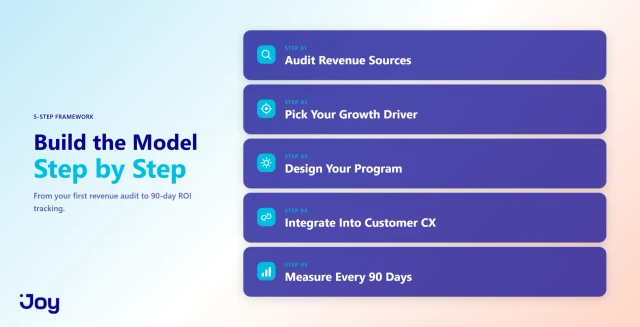
Step 1. Audit where your revenue actually comes from
Before you build anything, look at your data.
What percentage of your revenue comes from repeat customers versus first-time buyers? What's your repeat purchase rate? What's the average gap between a customer's first and second order?
If 70% of your revenue depends on new customers, you're running an acquisition model whether you planned to or not. The loyalty business model starts with knowing your baseline so you can measure progress against it.
A quick way to check: In Shopify, go to Analytics and look at your "Returning customer rate." The industry average for e-commerce sits around 28% to 30%. If you're below that, there's real room to grow before you do anything fancy.
Step 2. Pick your primary growth driver
Based on the three approaches above, decide what you're optimizing for. Frequency? Lifetime spent? Emotional loyalty?
Pick one. You can layer in elements of the others later, but starting with a single focus keeps your program sharp.
Here's what that looks like in practice: if you sell coffee and your average customer buys every six weeks, your primary driver is frequency. Your goal is to shorten that gap to four weeks. Every loyalty decision you make should serve that target.
Step 3. Design your program around that driver
Now you choose the tactical tools. This is where program types (points, tiers, referrals, subscriptions) come in. But the business model dictates the program design, not the other way around.
If you're running a frequency-first model, you need a fast earn-to-redeem ratio. Customers should hit their first reward within one to two purchases. Add auto-reorder incentives and streak bonuses for consecutive orders.
If you're running a value-escalation model, build a tiered structure with clear, achievable thresholds. Perks should feel exclusive, not just discounted. Early access, free shipping, and VIP events work better here than percentage-off coupons.
If you're running a community-and-values model, focus on referral rewards, cause-based redemptions, and UGC incentives that deepen the relationship.
One thing to keep in mind: 45% of consumers say earning rewards takes too long. Whatever model you choose, make sure the first reward feels reachable. If customers have to spend $300 before they earn a $5 discount, they'll check out mentally before they check out literally.
Step 4. Integrate loyalty into your entire customer experience
A rewards program that sits in a corner of your website won't create a business model shift. Loyalty needs to show up at the moments that matter:
- Post-purchase email: "You earned 120 points on this order. You're 80 points from your next reward."
- Cart page: "You're 50 points away from free shipping."
- Account dashboard: Clear balance, next reward threshold, and tier progress.
- Customer support: Your team should know a customer's loyalty status and purchase history before the conversation begins.
This is what separates a loyalty program from a loyalty business model. The program is a feature. The model means loyalty shapes how every part of your business operates.
Step 5. Measure, learn, and adjust every 90 days
Don't launch and forget. Set a 90-day review cadence and track these four metrics:
- Enrollment rate: Are customers signing up?
- Redemption rate: Are they actually using their rewards? Members who redeem spend 3.1x more per year than those who don't. If your redemption rate is low, your rewards aren't compelling enough.
- Repeat purchase rate (members vs. non-members): This is the clearest signal of whether the model is working.
- Customer lifetime value: Is the CLV of loyalty members increasing over time compared to non-members?
To calculate your program's ROI, use this formula:
If your store generated $750,000 in incremental profit from the program and it cost $250,000 to run, that's a 200% ROI. Every dollar you spent brought back two.
For context, 90% of companies with loyalty programs report positive ROI, with an average return of 4.8x. But that doesn't happen in month one. Give it 6 to 12 months before expecting the compounding effect to show up clearly in your numbers.
V. What Breaks a Loyalty Business Model (and How to Avoid It)
The model works. But it breaks in predictable ways. Here are the five most common failure patterns.
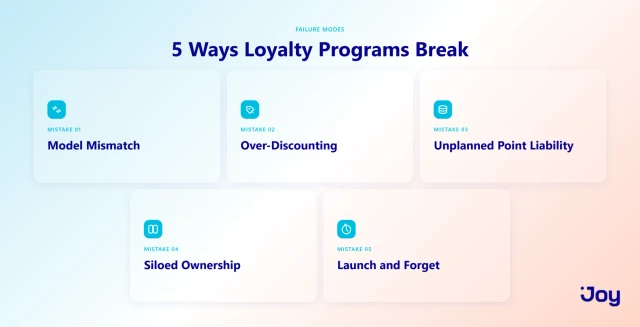
1. Model mismatch
This is the most expensive mistake. A furniture store running a frequency-first model will spend money on rewards that nobody earns, because customers don't buy couches every month. A commodity brand competing on price alone will struggle with a value-escalation model, because there's no aspirational pull to move customers up tiers.
The fix: match your model to your product's natural repurchase cycle and your customer's actual behavior. If you skipped Step 1 in the framework above (auditing your revenue), go back and do it before you design anything.
2. Over-discounting that eats your margins
When loyalty becomes a permanent coupon machine, you train customers to expect lower prices on every order. The program costs more than the revenue it generates, and you've created a discount dependency that's hard to unwind.
The fix: mix monetary rewards (discounts, store credit) with non-monetary ones (early access, exclusive products, VIP experiences). The goal is perceived value, not just a lower price tag.
3. Point liability you didn't plan for
Every point you issue is a financial promise. If 10,000 customers each hold $5 in unredeemed points, that's $50,000 in future liability sitting on your books. Most stores don't think about this until the balance gets uncomfortably large.
The fix: set expiration policies from day one. Points that expire after 12 months of inactivity are standard and fair, as long as you clearly communicate the policy. For reference, the typical e-commerce redemption rate is around 13% to 14%, but growing stores should plan for higher as their program gains traction.
4. Treating loyalty as marketing's job
If only the marketing team thinks about loyalty, you don't have a business model. You have a campaign. Loyalty touches product decisions (what to offer as rewards), customer support (how to treat VIP members), operations (fulfillment speed for top-tier customers), and communication (what emails go out and when).
The fix: make loyalty cross-functional. If it lives in one department, it's not a model.
5. Launching and forgetting
A loyalty program isn't a set-it-and-forget-it feature. 64% of companies that made significant changes to their programs reported better customer satisfaction than those that didn't update. Programs that sit untouched drift out of alignment with customer expectations, product mix, and market conditions.
The fix: quarterly reviews, annual refreshes, and ongoing customer feedback. Watch which rewards go unused. Ask customers what they actually want. Adjust.
VI. Is This Model Right for Your Store?
Not every store should build its entire growth strategy around loyalty. Here's an honest look at where this model fits and where it doesn't.
It works well when:
- Your product has natural repeat purchase potential (consumables, skincare, fashion, food)
- Your margins can support rewards without going negative
- You have a direct relationship with customers through your own store and email list
- Your brand gives people a reason to come back beyond price, whether that's quality, community, or identity
It works less well when:
- Your product is a one-time purchase (furniture, wedding dresses, specialty equipment)
- Your margins are thin, and you compete primarily on price
- You don't have customer data or a direct way to communicate with buyers
That said, it's a spectrum, not a binary choice. A furniture store probably shouldn't run a points-per-dollar program. But building a strong referral program, investing in post-purchase support, and creating content that keeps past buyers engaged? That's still retention thinking. And it still reduces your dependence on paid acquisition.
Even stores that don't fit the full model can borrow from it.
VII. Start With the Model, Not the Program
Most stores start with a program and hope it creates loyalty. The ones that succeed start with a business model and build a program that serves it.
If you're not sure where to begin, start with your data. Open your Shopify analytics. Look at your return customer rate, repeat purchase rate, and the average time between a customer's first and second orders.
Those three numbers will tell you which business model approach fits your store. Start there.